Section 06 · Styling
Bar carts for dining rooms
A dining room cart has to survive chairs being pulled out in front of it. That makes depth the binding constraint and length the free one, which is the opposite of how most carts are sold.
We earn a commission if you buy through our links, at no extra cost to you. We have not tested these carts. Here is what we did instead.
The shortlist
Quick picks
Tap a row for the full write-up. The price button opens Amazon.
| # | Product | Best for | Price |
|---|---|---|---|
| 01 | 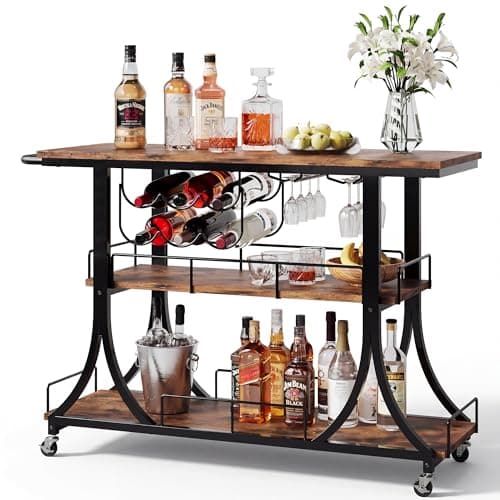 PETKABOO 3-Tier Rustic Wooden Bar Cart (HSC123WF) Sold as solid wood rather than a finish over board, and the published ratings are given per tier rather than as one headline: 110 lb top, 90 lb middle, 110 lb bottom. | Solid wood, long walls | |
| 02 | 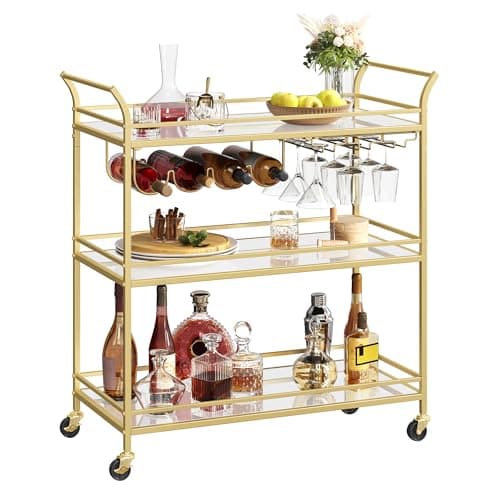 VASAGLE Large Gold Bar Cart (ULRC083A02) At 33.9 inches wide this stops being a side table and starts being a bar. | Serving a crowd | $80.99 · View on Amazon
|
| 03 | 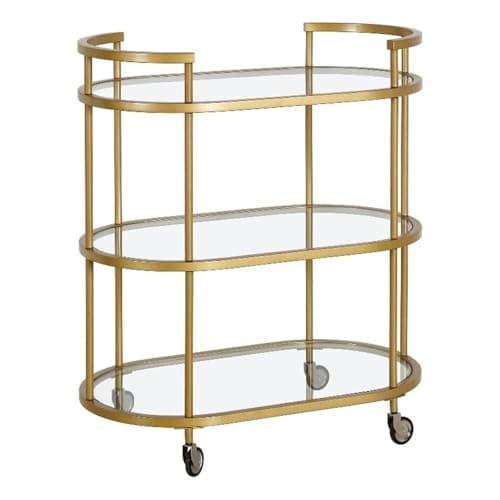 Henn&Hart 30-inch Oval Bar Cart in Brass (BC1147) Three tempered glass shelves on a brass-finished oval frame, 30 inches wide and 35.25 tall at 35.5 lb. | Three tiers, in brass | |
| 04 | 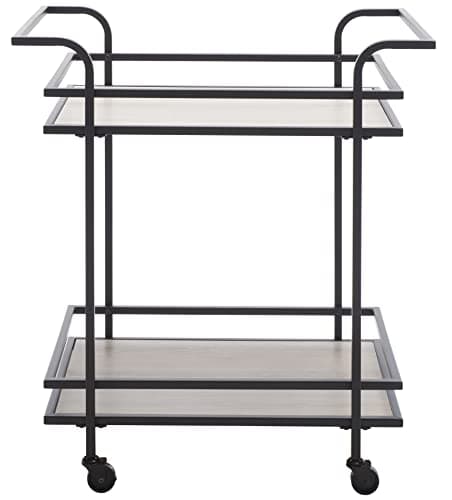 Safavieh Lameris 2-Tier Bar Cart with Handles, Matte Black (BCT8011A) The cart in this range that publishes the two things most of the category leaves off: curved handles at both ends and protective rails on the shelves. | Handles and rails | |
| 05 | 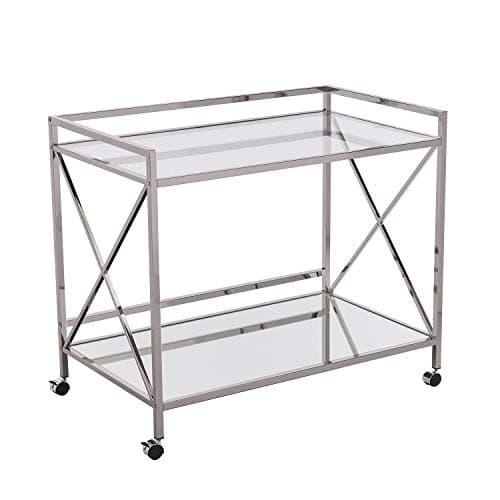 SEI Furniture Maxton Polished Steel Bar Cart (AMZ0402ZH) 23.25 inches deep and 38.75 wide on plated iron, with a tempered glass top over a mirrored lower shelf and a published 70 lb total — stated as 35 lb per shelf, which is the honest way to publish it. | Depth, and a per-shelf number |
#ad · We earn a commission on qualifying Amazon purchases, at no extra cost to you. Prices come from Amazon and change.
Buy the PETKABOO HSC123WF if the cart lives against the dining wall, and the SEI Maxton if it lives against a wall with no chairs in front of it. Everything on this page follows from that distinction, because a dining room has two completely different kinds of wall and most buyers only measure one of them.
The wall behind the chairs is the one that defeats carts. A diner pushes a chair back to stand up, and that movement needs roughly the depth of the chair again behind it. Put a 19-inch-deep cart on that wall and it is either in the way or it is permanently inaccessible with someone sitting in front of it. Put a 14-inch cart there and it survives.
The other wall — the one along the side of the room, or opposite the table — has no chair zone at all, and on that wall depth stops being a constraint and becomes the whole point. A deep cart is a serving surface you can build a drink on; a shallow one is a shelf you keep bottles on. The site's wider placement arithmetic, including the 18-inch standing rule, is on where to put a bar cart, which already names the dining wall as the placement that wants something long and shallow.
What I compared them on
Depth, first and hardest. Three of these five are 15 inches or under, which is what the chair wall needs. Two are not, and they are here for the other wall. This is the reverse of how the category is usually ranked, where a deep shelf reads as generous.
Length, because a dining room is the one room that has it. A dining wall is usually the longest clear run in the house, and length is the cheapest capacity there is — it costs nothing in walkway and it is the only dimension that does not fight the chairs. One cart here is 44 inches long.
Height against the table. A Plank+Beam 72-inch dining table publishes 30 inches of height. Every cart here is 32 to 35 inches, so the cart top sits two to five inches above the table — which is the right way round for serving, because you pour downward onto the table rather than lifting over a lip. It also means the cart reads as a taller object in the room than the table, and against a long low table that is a composition decision as much as a practical one.
Glass storage, because a dining room is where stemware gets used. Two of these carry published stemware racks. Hanging the glasses rather than standing them is what makes a shallow cart work, and the method generally is on how to store glasses on a cart.
The five, compared on published figures
| Cart | L x D x H (in) | Chair wall? | Load, as published |
|---|---|---|---|
| PETKABOO HSC123WF | 44.49 x 14.3 x 33.9 | Yes | 110 / 90 / 110 lb |
| VASAGLE ULRC083A02 | 33.9 x 15 x 35.4 | Yes | 66 lb per shelf |
| Henn&Hart BC1147 (oval) | 30 x 17 x 34.25 | Tight | Not published |
| Safavieh Lameris BCT8011A | 29.5 x 17.9 x 32.6 | Tight | 30 lb, whole cart |
| SEI Maxton AMZ0402ZH | 38.75 x 23.25 x 32.25 | No | 35 lb per shelf (70 total) |
The five, and who each is for
The pick (PETKABOO HSC123WF). Best for the wall behind the chairs. 44.49 inches long on 14.3 inches of depth, which is the exact shape the dining wall wants, and published loads of 110 lb on the top shelf, 90 on the middle and 110 on the bottom — stated per shelf rather than as a single total, which is the honest way to publish and the rarer one. Solid wood rather than veneered board, which matters more in a dining room than anywhere else because it sits next to wooden furniture that will show it up. It is reviewed in full at HSC123WF. Against it: 42.2 lb empty makes it a two-person reposition, 44.49 inches is longer than many dining walls have clear, and solid wood at this price means a rustic finish rather than a fine one.
The stemware one (VASAGLE ULRC083A02). Best for wine glasses within reach of the table. 33.9 inches long on 15 of depth, three mirrored tempered glass shelves at a published 66 lb each, with a wine rack and hanging glass holders. In a dining room the holders are the feature: stemware hung under a shelf is out of the way of the serving surface and two steps from the table, which is the whole argument for a cart in this room rather than a sideboard. It is reviewed at ULRC083A02. The costs: 36 lb is heavy for a glass-shelf cart, mirrored shelves show every ring from a wet glass — which a dining room produces in quantity — and the gold finish commits the room to a warm metal.
The no-corners one (Henn&Hart BC1147). Best for a dining room where people squeeze past. A 30-inch oval with three tempered glass shelves on a brass-finished frame. The oval is the reason to buy it here: a rectangular cart on a dining wall has two corners at hip height exactly where someone standing up from a chair will meet them, and an oval has none. It publishes no load rating of any kind, which at this price is hard to defend, 17 inches of depth makes the chair wall tight rather than comfortable, and 35.5 lb on an oval frame means there is no flat side to grip when you move it.
The one you carry (Safavieh Lameris BCT8011A). Best for serving at the table rather than beside it. 29.5 by 17.9 inches in matte black with gray veneer shelves and — the point — a real handle, which makes it the one cart here you can steer one-handed with a tray in the other. 23.3 lb is light enough that steering is pleasant. Its published capacity is 30 lb for the whole cart, which is the lowest figure on this page and about ten full bottles across two shelves; the veneer is a board finish among solid-wood dining furniture; and matte black shows dust in a room with candles in it.
The serving surface (SEI Maxton AMZ0402ZH). Best for the wall with no chairs in front of it. 23.25 inches deep and 38.75 wide — the most working surface in this registry — with a clear tempered top over a mirrored lower shelf and a published 35 lb per shelf stated alongside a 70 lb total. On a side wall or opposite the table it is the only cart here you can actually build drinks on, with room for a bucket and a board at the same time. On the chair wall it is the wrong cart entirely: 23.25 inches of depth leaves a 36-inch route at 12.75 inches, which is not a route. It is also 42 lb, and the mirrored lower shelf is the surface you will wipe most, as the mirrored roundup explains.
Cart or sideboard, for this room specifically
The dining room is the one room where the cart has a serious rival, and the honest answer depends on a single question: does the thing need to move?
A sideboard gives you more storage per inch of wall, closed doors, and a surface at a sensible height, and it gives up mobility entirely. A cart gives you a serving surface that can come to the table, go to the kitchen for ice and then return to the wall, and it gives up roughly half the storage. The full comparison, with the storage arithmetic, is on bar cart or sideboard.
For most dining rooms the cart wins on one specific evening: the one where eight people are seated and someone needs to pour without walking round the table twice. That is a mobility problem, and a sideboard cannot solve it.
What goes on a dining room cart
A dining room changes the list from the living-room version in three ways.
Wine takes over from spirits. A dining cart earns its place by holding what gets drunk at a table, and that is mostly wine — which means bottle slots and stemware rather than a shaker and a jigger. The carts with racks here hold six and the loose bottles stand behind them; the full rack-versus-shelf comparison is on carts with wine racks.
A tray earns its space twice over. In other rooms a tray is a boundary that keeps the arrangement tidy. In a dining room it is also the thing you lift off and carry to the table, which makes the depth question concrete: a standard tray is about 12 by 16 inches, so the 14.3 and 15 inch carts here take one square-on and the shallower carts on this site do not. Sizes are on bar cart trays.
Candles and a cart are a bad combination. Worth saying plainly because dining rooms are where candles live: an open flame on a wheeled object at hip height, next to bottles, is the one thing that genuinely does not belong on a cart. Put them on the table. What does belong, and how to arrange it, is on the decor that earns its space.
Matching it to the furniture that is already there
A dining room is usually the most matched room in a house — a table and six chairs bought together — and dropping a cart into it is the hardest finish decision on this site.
The rule that holds: match the cart to the metal in the room rather than to the wood. Wood tones almost never match across manufacturers and a near-miss reads worse than a deliberate contrast, whereas a brass cart beside a brass light fitting reads as intentional even when the woods are different. That reasoning in full, including which pairings reliably work, is on how to choose a bar cart finish.
The exception is the solid-wood cart. The PETKABOO is the one cart here that can sit beside a solid-wood table as the same kind of object rather than as a contrast, and if the room is farmhouse rather than modern that is worth more than any metal pairing.
Before you order
Pick the wall before the cart. Stand at the table, push a chair all the way back, and measure from the wall to the back of the chair — that number, not the width of the wall, is the depth you can buy. If it is under 16 inches you are buying from the first two rows of the table above.
Then check the length against the clear run, remembering that length is free here in a way it is not in any other room. Then read the load rating: one cart on this page publishes 110 lb per shelf and one publishes 30 lb for the whole thing, and the difference is roughly thirty bottles. The conversion is on weight capacity.
Every pick, in order
The full write-ups
Pick 01 · Solid wood, long walls
PETKABOO 3-Tier Rustic Wooden Bar Cart (HSC123WF)
PETKABOO
Sold as solid wood rather than a finish over board, and the published ratings are given per tier rather than as one headline: 110 lb top, 90 lb middle, 110 lb bottom. At 44.49 inches it is the longest cart here by a wide margin, which is either exactly what a bare wall needs or completely unusable.
- Dimensions
- 44.49"L x 14.3"W x 33.9"H
- Weight
- 42.2 lb
- Load, top shelf
- 110 lb
- Load, middle shelf
- 90 lb
- Load, bottom shelf
- 110 lb
- Materials
- Solid wood, per the listing
Specs compiled from: PETKABOO HSC123WF published listing, retrieved 2026-09-03.
What is good
- Per-tier load ratings published individually rather than as one headline number
- 44.49 inches of length is more usable surface than anything else here
- Four casters with two brakes, so it parks rather than drifts
What is not
- 42.2 lb is a cart you position once and then leave alone
- The listing describes solid wood construction and then names aluminum as the frame material
- The retailer dimension field reads 44.4 deep by 33.85 wide by 14.3 high, which scrambles the axes against the description
#ad Disclosure · Price as of October 17, 2026
Pick 02 · Serving a crowd
VASAGLE Large Gold Bar Cart (ULRC083A02)
VASAGLE
At 33.9 inches wide this stops being a side table and starts being a bar. Same 66 lb per-shelf rating as the small model, far more top-shelf area, and 36 lb of cart to shift when you want the room back.
- Dimensions
- 15"D x 33.9"W x 35.4"H
- Weight
- 36 lb (16.3 kg)
- Load per shelf
- 66 lb (30 kg) static
- Materials
- Steel frame, mirrored tempered glass
- Shelves
- 3, with wine and glass holders
Specs compiled from: VASAGLE ULRC083A02 published listing, retrieved 2026-09-02.
What is good
- 33.9 inches of width fits bottles and glassware without stacking
- Still only 15 inches deep, so it does not eat walkway the way its width suggests
- The published load rating did not drop as the shelf got wider
What is not
- 36 lb is a two-handed cart, and it will not roll easily on thick pile
- At nearly 34 inches wide it needs a wall it can own
- Overkill if you own fewer than about eight bottles
Pick 03 · Three tiers, in brass
Henn&Hart 30-inch Oval Bar Cart in Brass (BC1147)
Henn&Hart
Three tempered glass shelves on a brass-finished oval frame, 30 inches wide and 35.25 tall at 35.5 lb. It is the only three-tier brass cart I could verify as purchasable, and the only one in the finish that reaches the top of the serving band.
- Dimensions
- 17"D x 30"W x 35.25"H
- Weight
- 35.5 lb
- Load
- Not published
- Materials
- Brass-finished metal, tempered glass
- Shelves
- 3
Specs compiled from: Henn&Hart BC1147 published listing, retrieved 2026-10-03.
What is good
- Three tiers, where the rest of the brass category is two
- 35.25 inches sits at the top of the 32 to 36 inch serving band
- Tempered glass on all three shelves rather than mirrored
What is not
- Publishes no load rating of any kind
- An oval frame wastes the corners a rectangle would use
- 35.5 lb makes it a two-handed object to reposition
#ad Disclosure · Price as of October 17, 2026
Pick 04 · Handles and rails
Safavieh Lameris 2-Tier Bar Cart with Handles, Matte Black (BCT8011A)
SAFAVIEH
The cart in this range that publishes the two things most of the category leaves off: curved handles at both ends and protective rails on the shelves. 29.5 inches wide, 23.3 lb, matte black powder coat over gray veneer, and a published 30 lb for the whole cart.
- Dimensions
- 17.9"D x 29.5"W x 32.6"H
- Weight
- 23.3 lb
- Load, whole cart
- 30 lb
- Materials
- Black powder-coated metal, gray veneer shelves
- Shelves
- 2
Specs compiled from: Safavieh Lameris BCT8011A product page and Amazon listing, retrieved 2026-09-19.
What is good
- Curved handles and protective rails, which most carts this size leave off
- 32.6 inches is inside the 32 to 36 inch serving band
- Veneer shelves rather than glass, so fingerprints and water rings do not show
What is not
- 30 lb for the whole cart is about ten full bottles across both shelves
- Veneer over engineered board swells permanently if a spill sits at a cut edge
- Safavieh publishes no material for the shelves beyond a gray veneer
#ad Disclosure · Price as of October 17, 2026
Pick 05 · Depth, and a per-shelf number
SEI Furniture Maxton Polished Steel Bar Cart (AMZ0402ZH)
SEI Furniture
23.25 inches deep and 38.75 wide on plated iron, with a tempered glass top over a mirrored lower shelf and a published 70 lb total — stated as 35 lb per shelf, which is the honest way to publish it. The biggest working surface in this registry.
- Dimensions
- 23.25"D x 38.75"W x 32.25"H
- Weight
- 42 lb
- Load per shelf
- 35 lb (70 lb total)
- Materials
- Plated iron, tempered glass, mirrored glass
- Shelves
- 2
Specs compiled from: SEI Furniture Maxton AMZ0402ZH published listing, retrieved 2026-09-21.
What is good
- 23.25 inches of depth takes a full-size tray with room to work beside it
- Publishes per-shelf and total load rather than one headline figure
- 42 lb of plated iron does not move when you pour
What is not
- 42 lb makes repositioning a two-handed job
- The lower shelf is mirrored, so it is the surface you will wipe most
- 38.75 inches needs a genuine run of wall
#ad Disclosure · Price as of October 17, 2026
How these were picked
I have not tested any of these carts. What I did instead: compiled the published specifications from each listing, recorded the figures with their source, checked the footprint against the clearances a real room has, worked out how many standard bottles a stated shelf actually holds, and named the one I would skip. Where two listings for the same cart disagree, the page says so rather than quietly picking one.
Frequently asked
Questions
How deep can a bar cart be in a dining room?
Should a dining room bar cart match the dining table?
Is a bar cart or a sideboard better for a dining room?
How tall should a dining room bar cart be?
Sources
Where the facts on this page came from
- PETKABOO HSC123WF published listing (44.49 in length, 110 / 90 / 110 lb per shelf)
- Henn&Hart BC1147 published listing (30 in oval, three tempered glass shelves)
- Safavieh Lameris BCT8011A published listing (29.5 x 17.9 x 32.6, 30 lb capacity)
- Plank+Beam 72-inch dining table published dimensions (30 in height)
- Standard 750 ml wine bottle dimensions — Dimensions.com
Specifications attributed to a retailer listing were read from that listing on the date shown on each product card. Listings change; if you find one that no longer matches what we published, tell us and we will check it and correct the page.
Read next
Related pages
Filed under Styling. Permanent link: /styling/bar-carts-for-dining-rooms