Section 06 · Styling
Bar carts for the kitchen
A kitchen is the one room that imposes its own height on furniture. Here is what a 36-inch counter does to the shortlist, and the five carts that survive the room.
We earn a commission if you buy through our links, at no extra cost to you. We have not tested these carts. Here is what we did instead.

The shortlist
Quick picks
Tap a row for the full write-up. The price button opens Amazon.
| # | Product | Best for | Price |
|---|---|---|---|
| 01 | 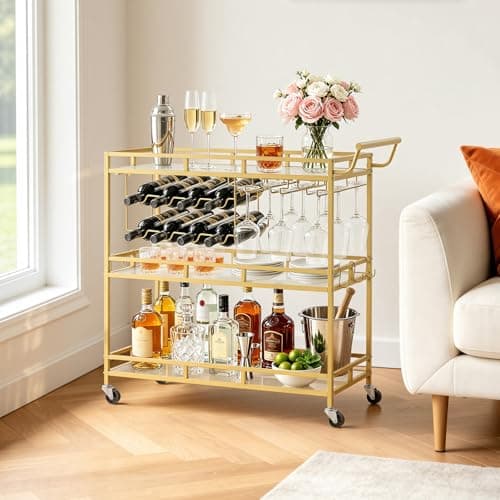 VEVOR 3-Tier Glass Bar Cart (SS-4) 44 lb per shelf on a 0.7 mm powder-coated iron frame with glass shelves, 34.64 inches wide and 35.04 tall. | A per-shelf rating in a kitchen | |
| 02 | 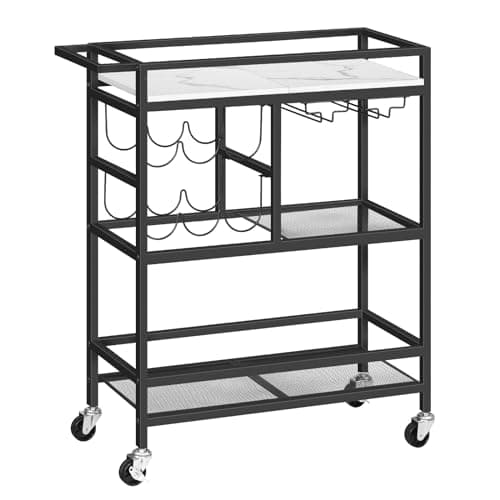 MAHANCRIS 3-Tier Kitchen Serving Cart with Wine Rack (RCHM6101) 66 lb per layer on a cart 11 inches deep, with a wine rack for six bottles, six goblet holders, and four adjustable feet as well as casters — so it can be set up to roll or to stand still.. | 66 lb a shelf at 11 inches deep | $45.99 · View on Amazon
|
| 03 | 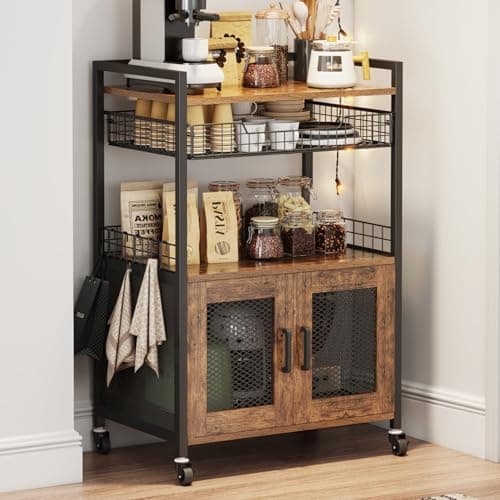 Hencawima 3-Tier Coffee Bar Cabinet on Wheels (CFG-FX) The closest thing in this category to a bar cart that genuinely closes: three tiers on castors with a two-door cabinet underneath, a wire basket drawer and five hooks. | Doors and a drawer | |
| 04 | 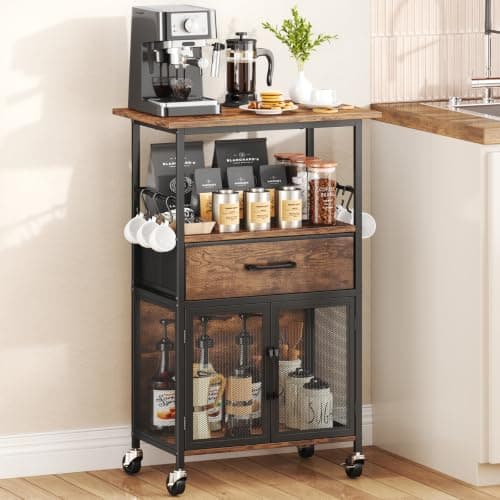 SWTYMIKI Rolling Kitchen Island Cart with Drawer and Cabinet (ZWJ320) An open top shelf over a drawer and a mesh-door cabinet, 20.47 inches wide and 18.92 lb. | A drawer and a closed cabinet | $49.99 · View on Amazon
|
| 05 | 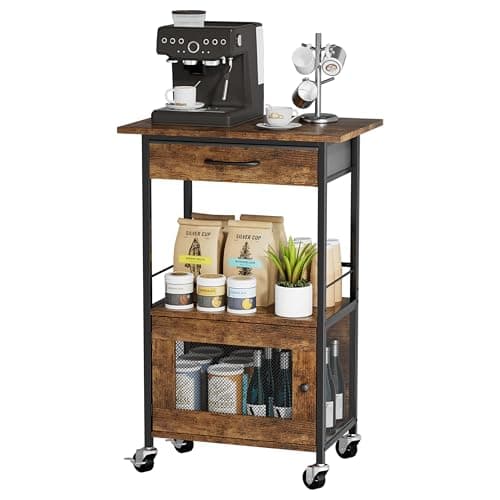 SWTYMIKI Rolling Coffee Bar Cabinet (ZWJ279) 17.6 lb, a magnetic transparent door over the bottom cabinet, a hidden drawer above it and four wheels. | The cheapest door |
#ad · We earn a commission on qualifying Amazon purchases, at no extra cost to you. Prices come from Amazon and change.
Every other room lets a bar cart be whatever height it wants. A kitchen does not, because a kitchen already has a work surface at a standard height and anything alongside it either lines up or looks like a mistake.
American counters run about 36 inches. The bar cart serving band is 32 to 36. So in a kitchen you are shopping the very top of the usual range, and most of what this site recommends elsewhere — the 32-inch carts, the low deco ones — is three or four inches short. That gap is small enough to ignore in a photograph and obvious in the room.
The pick is the VEVOR SS-4 at 35.04 inches, which is within an inch of a counter and publishes 44 lb a shelf.
The three things a kitchen adds
Height, against 36 inches. A cart that sits flush with the counter effectively extends it — you can slide things across. A cart three inches lower does not extend anything; it becomes a step in the surface, and in a narrow kitchen that step is where things get knocked over. Two of the five here clear 34 inches; the rest are honest compromises.
Grease, which is a genuinely different problem from spills. Airborne cooking oil settles on every horizontal surface within a few feet of a hob, and it does not evaporate. On glass and powder-coated metal it wipes off. On unsealed board edges and woven surfaces it soaks in and goes sticky, collecting dust. This is the specification nobody lists, and it is the reason a kitchen cart should be glass, metal or sealed surface wherever possible.
Closed storage, for the same reason. An open shelf in a living room collects dust. An open shelf in a kitchen collects dust in a film of oil. A drawer or a cabinet door is worth more here than anywhere else in the house, which is why two of these five have one.
Everything else — load rating, depth, casters — matters exactly as much as it does in any other room, and is covered on bar cart weight capacity and wheels and casters.
The five, and who each is for
The pick (VEVOR SS-4). 35.04 inches tall — within an inch of a standard counter — 34.64 wide, with glass shelves on a powder-coated iron frame and a published 44 lb per shelf. It is the only cart here that gets the height, the wipe-clean surface and a per-shelf figure all at once. Three honest costs: 37.04 lb makes it a two-handed object, only two of its four casters lock, and at 14.96 inches deep it is shallower than a 24-inch counter, so it sits beside one rather than extending it.
The strongest per shelf (MAHANCRIS RCHM6101). 66 lb a layer, which is the best figure on this page, on a cart just 11 inches deep with a six-bottle wine rack and six goblet holders. The detail that earns its place in a kitchen is the four adjustable feet supplied alongside the casters: you can set it up to roll, or set it up to stand still against a run of units, which is what most kitchen carts actually do. It publishes no item weight, 11 inches will not take a standard tray flat, and the board edges are the weak point around water.
The coffee cabinet (Hencawima CFG-FX). A three-tier cabinet on wheels with doors, already the backbone of the coffee cart page. In a kitchen the doors do the work: mugs, pods, filters and sugar live behind them rather than collecting a film of cooking oil. It is a cabinet rather than a cart, so it is heavier and less mobile than the open designs here.
The one with a drawer (SWTYMIKI ZWJ320). An open top over a drawer and a mesh-door cabinet at 20.47 inches wide and 18.92 lb. A drawer is the storage type a kitchen uses most and the one bar carts almost never have — openers, foil, spoons, the things that have no home on an open shelf. Mesh doors let you see what is inside. It publishes no load rating, 13.78 inches deep will not take a standard tray square-on, and the panels are wood-style rather than wood.
The wider cabinet (SWTYMIKI ZWJ279). The larger rolling coffee-bar cabinet, for a kitchen with a spare wall rather than a spare corner. Same argument as the Hencawima — closed storage where the air is greasy — with more of it. Same trade too: cabinets are heavy, and a heavy cabinet on casters is something you position once rather than move nightly.
Cleaning a cart that lives in a kitchen
The maintenance is different here, because the dirt is different. A living room cart collects dust; a kitchen cart collects a thin film of cooking oil with dust stuck to it, and the two need different treatment.
Degrease the frame, not just the shelves. The film settles on uprights and caster stems as readily as on horizontal surfaces, and the frame is where it goes unnoticed until it feels tacky. Warm water with a little dish soap is the right tool and the mildest one that works.
Keep kitchen sprays off painted and plated finishes. Most degreasing sprays are formulated to strip, and on a powder-coated or plated frame that means dulling over time — the surface looks fine for a few months and then noticeably flat. Use them on glass and stainless, not on the frame.
Take the casters seriously. Kitchen floors combine grease with crumbs and the mixture packs into caster housings, which is the single most common reason a kitchen cart starts rolling badly. A cocktail stick around the axle twice a year fixes what people usually assume is a broken wheel.
What belongs on a kitchen cart
A kitchen cart earns its floor space by taking a job away from the counter, and there are four jobs it does better than a cupboard does.
The coffee station. Machine, beans, cups and the thing you grind into, all in one place that is not the counter you need for cooking. This is the most common use and the one the cabinet designs here are built for — the full setup, including which machines physically fit, is on coffee bar cart setup.
The overflow that has nowhere else. Oils and vinegars in use, the fruit bowl, the bread bin — things that live out because they are used daily and make a counter look cluttered because they have no assigned spot.
The handover point. Plates going to the table, dishes coming back, drinks for people who are in the way. A cart at the boundary between kitchen and dining room absorbs the traffic that otherwise happens across a worktop.
The actual bar, kept out of the cooking zone. Bottles and glassware do not want to be next to a hob, but they are often kept in a kitchen anyway. A cart lets the bar live at the far end of the room, which is both better for the bottles and better for the cook.
What does not belong: anything that needs to be plugged in permanently and anything heavy enough that you would not want it moving. A microwave on a cart with two locking casters is a worse idea than it looks, for reasons covered on bar carts with mini fridges.
Where the cart should actually go
Kitchens have three plausible positions and they suit different carts.
At the end of a run of units, effectively extending the counter. This wants the tallest cart you can find and a locking caster, because a cart that rolls when you lean on it is worse than no cart. The VEVOR is the one to use here.
Against a free wall, as a coffee or drinks station. Height matters less, closed storage matters more, and this is where the cabinets earn their place.
In the gap between the kitchen and the dining area, as a handover point. This wants depth under 12 inches so it does not narrow a walkway, which is exactly what the MAHANCRIS is for. The clearance arithmetic — 30 to 36 inches of passage — is on where to put a bar cart.
Kitchen cart or bar cart?
Search for a kitchen cart and you will mostly be shown microwave stands and utility trolleys: deeper, taller, usually with a butcher-block top and often no rails at all. They are built for appliances and prep rather than bottles and glasses.
The distinction that matters is what goes on top. If the cart will hold an appliance — a microwave, an air fryer, a stand mixer — buy the utility cart and check the shelf rating carefully, because appliance weight is concentrated and static. If it will hold bottles, glassware and a tray, buy the bar cart: the rails, the stem holders and the wine rack are worth more than the extra depth, and the whole argument for appliances on a cart is worked through on bar carts with mini fridges.
Before you order
Measure your counter — most are about 36 inches, but older kitchens vary — and decide whether the cart needs to line up with it or simply live nearby. Then check the surface: glass and powder-coated metal for the cooking zone, board and wood only at a distance from it.
Then look for a door or a drawer. In a kitchen, closed storage is not a luxury feature, it is the difference between clean mugs and mugs you rinse before using. The carts that close are on bar carts with doors.
And if the reason the cart is in the kitchen is that there is no counter left for the microwave, that is a different calculation with a published number behind it. Can a bar cart hold a microwave? adds the three inches of clearance the appliance maker asks for and finds that the shelf gap, not the weight rating, is what rules carts out.
Every pick, in order
The full write-ups
Pick 01 · A per-shelf rating in a kitchen
VEVOR 3-Tier Glass Bar Cart (SS-4)
VEVOR
44 lb per shelf on a 0.7 mm powder-coated iron frame with glass shelves, 34.64 inches wide and 35.04 tall. It publishes the figure most kitchen carts leave out and it sits within an inch of standard counter height.
- Dimensions
- 14.96"D x 34.64"W x 35.04"H
- Weight
- 37.04 lb
- Load per shelf
- 44 lb
- Materials
- Powder-coated iron, glass shelves
- Wheels
- 4 PP swivel, 2 lockable
Specs compiled from: VEVOR SS-4 published listing, retrieved 2026-09-21.
What is good
- 44 lb per shelf published, which is about fifteen full bottles a tier
- 35.04 inches sits within an inch of a 36-inch counter
- Glass shelves wipe clean of cooking grease in a way board does not
What is not
- 37.04 lb is a two-handed object to reposition
- Only two of the four casters lock
- 14.96 inches deep is shallower than a standard 24-inch counter, so it will not extend one
#ad Disclosure · Price as of October 17, 2026
Pick 02 · 66 lb a shelf at 11 inches deep
MAHANCRIS 3-Tier Kitchen Serving Cart with Wine Rack (RCHM6101)
MAHANCRIS
66 lb per layer on a cart 11 inches deep, with a wine rack for six bottles, six goblet holders, and four adjustable feet as well as casters — so it can be set up to roll or to stand still.
- Dimensions
- 11"D x 24.8"W x 32"H
- Weight
- Not published
- Load per shelf
- 66 lb
- Storage
- 3 tiers, 6-bottle rack, 6 goblet holders
- Wheels
- 4 casters (2 braked) plus 4 adjustable feet
Specs compiled from: MAHANCRIS RCHM6101 published listing, retrieved 2026-09-21.
What is good
- 66 lb a shelf is the strongest figure of any cart on this page
- 11 inches deep clears a walkway most kitchen carts block
- Adjustable feet as an alternative to casters, which no other cart here offers
What is not
- No published item weight
- 11 inches deep will not take a standard 12 by 16 inch tray flat
- Iron and wood-look board, so the shelf edges are the weak point around water
Pick 03 · Doors and a drawer
Hencawima 3-Tier Coffee Bar Cabinet on Wheels (CFG-FX)
Hencawima
The closest thing in this category to a bar cart that genuinely closes: three tiers on castors with a two-door cabinet underneath, a wire basket drawer and five hooks. It is sold as a coffee station, which is what almost every enclosed cart is sold as, and the shape works identically for bottles.
- Dimensions
- 15"D x 23.7"W x 35.9"H
- Load per shelf
- Not published
- Materials
- Carbon steel frame
- Storage
- 2-door cabinet, wire basket drawer, 5 hooks
- Shelves
- 3
Specs compiled from: Hencawima CFG-FX published listing, retrieved 2026-09-13.
What is good
- A real two-door cabinet, so the part of a bar you would rather not display can be shut away
- A wire basket drawer as well, which open carts never have
- 35.9 inches tall keeps the top surface at standing pouring height
What is not
- No published load rating on any shelf, and no published item weight either
- Doors need swing clearance in front, which an open cart does not
- It is marketed as a coffee station, so the listing photography shows mugs rather than bottles
#ad Disclosure · Price as of October 17, 2026
Pick 04 · A drawer and a closed cabinet
SWTYMIKI Rolling Kitchen Island Cart with Drawer and Cabinet (ZWJ320)
SWTYMIKI
An open top shelf over a drawer and a mesh-door cabinet, 20.47 inches wide and 18.92 lb. In a kitchen the closed storage is the point: it keeps the things that attract grease and dust off an open shelf.
- Dimensions
- 13.78"D x 20.47"W x 33.94"H
- Weight
- 18.92 lb
- Load
- Not published
- Storage
- Open top, 1 drawer, cabinet with mesh doors
- Wheels
- 4, two locking
Specs compiled from: SWTYMIKI ZWJ320 published listing, retrieved 2026-09-21.
What is good
- A drawer and a closed cabinet on a cart 20.47 inches wide
- Mesh doors let you see what is inside without opening them
- 18.92 lb moves easily between counter and table
What is not
- No published load rating
- 13.78 inches deep will not take a 12 by 16 inch tray square-on
- Wood-style panels rather than wood, so a standing spill is permanent
Pick 05 · The cheapest door
SWTYMIKI Rolling Coffee Bar Cabinet (ZWJ279)
SWTYMIKI
17.6 lb, a magnetic transparent door over the bottom cabinet, a hidden drawer above it and four wheels. It is the least expensive way I found to buy a drinks cart that actually closes, and the compromises are the ones you would expect at that end of the market.
- Dimensions
- 14.57"D x 18.9"W x 34.65"H
- Weight
- 17.6 lb
- Load per shelf
- Not published
- Materials
- Iron, wood and non-woven fabric
- Storage
- Door cabinet plus one drawer
Specs compiled from: SWTYMIKI ZWJ279 published listing, retrieved 2026-09-13.
What is good
- 17.6 lb, so unlike most enclosed carts it still moves with one hand
- A magnetic door that stays shut when the cart is pushed
- 34.65 inches tall sits inside the normal serving band
What is not
- No published load rating on any surface
- Non-woven fabric in the build is the part that will look tired first
- Its own listing gives the shelf count as one while showing several tiers
#ad Disclosure · Price as of October 17, 2026
How these were picked
I have not tested any of these carts. What I did instead: compiled the published specifications from each listing, recorded the figures with their source, checked the footprint against the clearances a real room has, worked out how many standard bottles a stated shelf actually holds, and named the one I would skip. Where two listings for the same cart disagree, the page says so rather than quietly picking one.
Frequently asked
Questions
How tall should a kitchen bar cart be?
What surface is best for a bar cart in a kitchen?
Is a kitchen cart the same as a bar cart?
Which kitchen bar cart holds the most weight?
Sources
Where the facts on this page came from
Specifications attributed to a retailer listing were read from that listing on the date shown on each product card. Listings change; if you find one that no longer matches what we published, tell us and we will check it and correct the page.
Read next
Related pages
Filed under Styling. Permanent link: /styling/bar-carts-for-the-kitchen