Section 01
Bar cart basics
Start here if you have not bought one yet. What the thing is, what it costs, and the honest case for using something you already own instead.
Orientation
What this section covers
A bar cart is a wheeled side table between roughly 32 and 36 inches tall with two or three open shelves. That is the whole definition. Everything else — the wine rack, the mirrored glass, the brass finish, the stem holders — is a variation on a trolley, and the trolley is the part that decides whether you like living with one.
The reason to start here rather than at a roundup is that most people who search for a bar cart are solving a problem that a bar cart is only one answer to. The problem is usually: the bottles are in a kitchen cupboard, the glasses are somewhere else, and pouring anyone a drink means three trips. A cart fixes that by putting the whole operation in one movable object. So does a tray on a console table, and so does a shelf. This section is honest about when the cart is the right answer and when it is an expensive way to buy a tray.
The three questions almost everyone asks in this order are: what is it, what does it cost, and why do the good ones cost so much more than the cheap ones? There is a page for each below, and the short version of all three is that the price gap is mostly frame rigidity and shelf material, both of which you can check on a listing before you buy.
There is a fourth question people ask before any of those and rarely say out loud, which is whether the whole idea is dated. Are bar carts out of style? answers it honestly: one specific version of the object went out of fashion around 2015 and the object itself did not, and are bar carts tacky? takes the sharper version of the same worry — four specific choices make one look it, and three are decided before you buy.
Then the two buying questions this section answers directly. The value tier is worked through in the budget roundup, which is really about the three things a price cut removes. And because the same two brands dominate that whole bracket, HOOBRO or VASAGLE? settles which of them to buy and on what basis. A step up from that bracket, which Safavieh bar cart to buy compares six models from the one furniture brand that publishes a capacity figure on almost everything it sells — figures that run from 11 lb to 50 lb. At the other end of the market, luxury bar carts asks what a premium actually buys, and finds that it buys solid material and mass rather than better published engineering.
What to buy
The picks in this section
Best First Cart
The best bar carts to start with
Five low-commitment carts under 22 lb, compared on published depth and shelf rating.
Top pick: HOOBRO 2-Tier Bar Cart (BF56TC01)
Best Budget Cart
The best budget bar carts
Five cheap carts compared on published rating, depth and weight — and what the price cut actually removes.
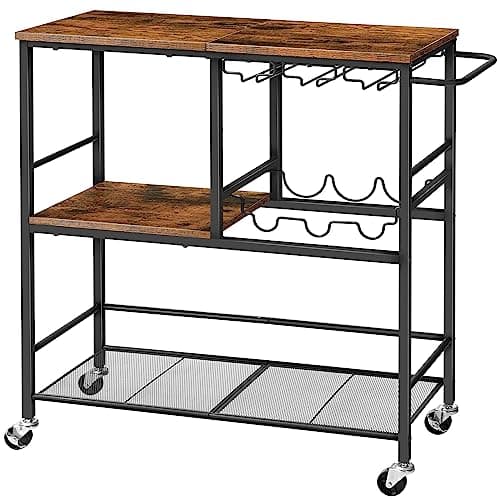
Top pick: HOOBRO 29.5-inch 3-Tier Serving Cart (BF21TC01)
#ad Disclosure · Price as of October 17, 2026
Least Tacky Cart
Are bar carts tacky?
Four choices that make a cart look tacky, all avoidable — and the carts that dodge them.
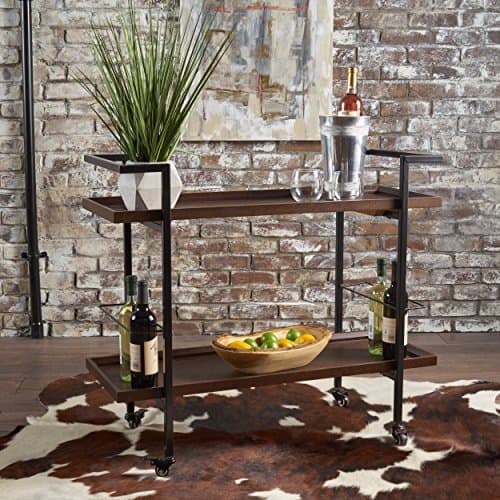
Top pick: Christopher Knight Home Gerard Bar Cart (301872)
#ad Disclosure · Price as of October 17, 2026
Best Safavieh Cart
Which Safavieh bar cart to buy
Six Safavieh carts compared on published capacity, height and depth — and why one brand's figures range from 11 lb to 50 lb.
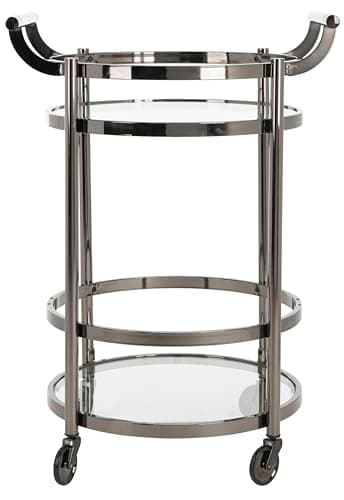
Top pick: Safavieh Sienna Bar Cart, Gunmetal and Glass (BCT8001A)
#ad Disclosure · Price as of October 17, 2026

Best Premium Cart
Luxury bar carts, and where the money stops working
Five premium carts compared on published load, materials and depth — and the point where price stops buying construction.
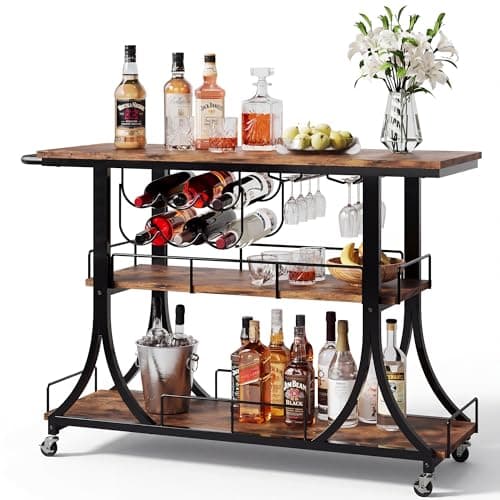
Top pick: PETKABOO 3-Tier Rustic Wooden Bar Cart (HSC123WF)
#ad Disclosure · Price as of October 17, 2026
Working it out
Guides and comparisons



The rest of the argument
What actually separates a cheap cart from an expensive one
Published load ratings are the most useful number nobody reads. Across the carts in our model library, the per-shelf figure ranges from 33 lb to 66 lb — a factor of two — and it correlates far better with how a cart feels in use than price does. A 750 ml bottle weighs roughly 2.5 to 3 lb full, so a 33 lb shelf is about six bottles once you account for a glass or two, and a 66 lb shelf is about twenty. If you own a dozen bottles, that single figure eliminates half the market before you look at a photograph.
Shelf material is the second divide. Particleboard is cheap and it works until a spill sits on a cut edge, at which point it swells and never recovers. Tempered glass wipes clean and does not care about liquid, but it chips at the edges if the cart is dragged over a threshold. Mirrored glass is glass with a fingerprint problem — it photographs beautifully and it needs wiping every time anyone touches it. Steel and solid wood are rarer at these prices and are usually what the extra money bought.
Frame rigidity is the third and the hardest to check remotely. A light cart is easier to move, which is the entire point of wheels, but a very light frame flexes when it crosses a door threshold and that is when glassware walks off a shelf. The Nathan James Hallie is the best example of the good version: 14 lb for a 27 inch cart with a 66 lb capacity. The bad version is a cart that weighs 11 lb because there is not much of it.
Once you have those three numbers you can shop by look rather than by hope. Our styles section covers the finishes, our sizing section covers whether the thing fits the room, and the cost page puts real published figures against each band so the price stops feeling arbitrary.
Every page in this section: The best bar carts to start with · Bar cart or tea cart? · What to use as a bar cart instead · Are bar carts out of style? · The best budget bar carts · Are bar carts tacky? · HOOBRO or VASAGLE? · What is a bar cart? · What do bar carts cost? · Why are bar carts so expensive? · Which Safavieh bar cart to buy · Luxury bar carts, and where the money stops working