Section 03 · Sizing
Where to put a bar cart
Five places one works, one rule about standing room, and the walkway arithmetic that decides whether the room still functions afterwards.
We earn a commission if you buy through our links, at no extra cost to you. We have not tested these carts. Here is what we did instead.
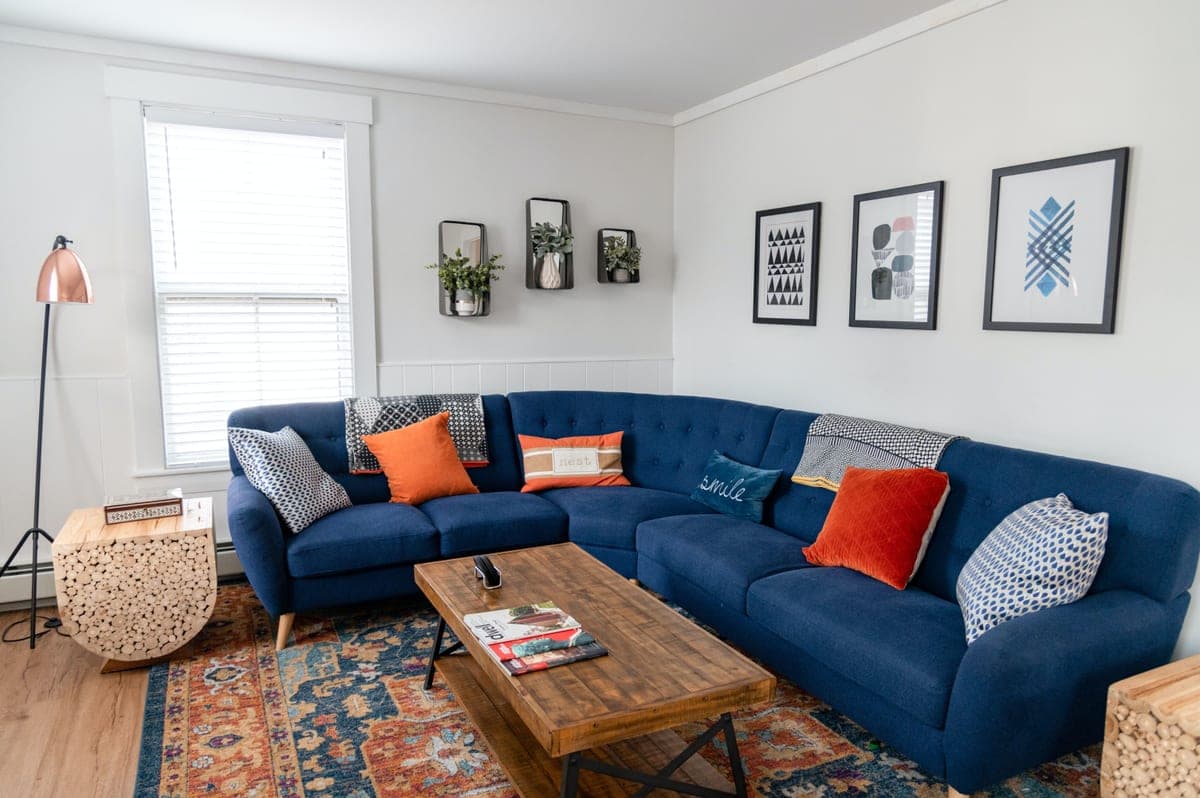
A cart that fits a wall does not necessarily fit a room. The measurement that decides it is not the cart's footprint but what is left over afterwards, and there is one number worth committing to memory: about 18 inches of clear standing room on the side you pour from. Less than that and you are reaching rather than serving, and the cart quietly stops being used.
The walkway arithmetic
Take the depth of the cart and subtract it from the width of the route it sits in. A 15 inch deep cart in a 36 inch hallway leaves 21 inches, which is passable but tight. An 11 inch deep cart in the same hallway leaves 25 inches, which is comfortable. A 19 inch deep cart leaves 17, which is a squeeze past for one person and impossible for two.
This is why depth matters more than width for placement, and why the shallowest carts in our library — the HOOBRO BF21TC01 at 11.2 inches and the BF35TC01 at 12.8 — are the ones to look at when the cart has to live somewhere people walk. Published depths for everything are in the dimensions reference.
The five placements that work
1. Beside the sofa
The most common and the most forgiving, because a cart here doubles as an end table. Match the height to the sofa arm within a few inches — a 32 inch cart beside a 28 inch arm reads correctly, a 36.5 inch one does not. You need the 18 inches of standing room to be at the front, not the side.
2. Against a dining room wall
The traditional placement, and the one that wants a long shallow cart rather than a deep one, because chairs pull out into the space. The HOOBRO BF21TC01 at 29.5 by 11.2 inches is almost exactly this shape.
3. The dead corner
Every room has one. A round cart wins here for a genuinely geometric reason: a circle wastes less of a corner than a rectangle, and there is no corner sticking out to catch a hip. The Nathan James Sage is the round option in our library.
4. Opposite the kitchen door
Practical rather than decorative — ice and mixers are steps away. This is almost always a walkway, so it is the placement where the depth arithmetic above binds hardest. Shallow cart, and check that the door swing does not hit it.
5. Under a window, if the window is not south-facing
Light is good for a cart and direct sun is not: it fades labels, it warms spirits, and it shows every mark on mirrored glass at exactly the angle you sit at. A north or east window is a good home for a cart; a south-facing one in a bright room is not.
Where a cart does not work
- Behind a door. Obvious in principle and constantly done in practice, because it is the empty wall. Check the door swing.
- In a main traffic route. A cart on wheels in a walkway moves, and a cart that moves spills.
- Anywhere you cannot get 18 inches in front of it. This is the rule that eliminates most of the tempting-looking gaps.
- Next to a radiator or heat source. Heat is bad for wine and for anything with a cork, and the temperature swing is worse than the temperature.
Floors and wheels
Placement and casters interact. On hard floors a light cart rolls when leaned on, which argues for a heavier cart or for locking wheels. On thick carpet the opposite: small hard casters sink and the cart stops being mobile at all, which makes the wheels decoration. Neither problem is visible on a listing photograph, and both are covered in the caster guide.
Once it has a home, the wall above it becomes part of the arrangement — what to put above a bar cart covers the sizing, and how to style a bar cart covers what goes on it.
One of those five placements has enough constraints of its own to need a separate page. The wall behind a dining table is the one where depth binds hardest, because chairs pull out into exactly the space the cart wants, and bar carts for dining rooms works that arithmetic through with the carts whose published depths survive it.
What I would buy
The picks this page points to
These sit here rather than at the top on purpose: the advice above is what decides the choice, and a recommendation only means something once you know what you are choosing between.
Corners and traffic
Nathan James Sage Round Rolling Cart
Nathan James
The round one, and the case for round is practical rather than decorative: no corners to catch a hip in a narrow room. 12 lb, 66 lb capacity, and the tallest cart here at 36.5 inches.
- Dimensions
- 20"D x 23"W x 36.5"H
- Weight
- 12 lb
- Weight capacity
- 66 lb
- Shape
- Round, two tiers
- Style
- Mid-century, retro
Specs compiled from: Nathan James Sage published listing, retrieved 2026-09-02.
What is good
- No corners, which is worth more than it sounds in a walkway
- 12 lb is among the lightest carts in this registry
- 66 lb capacity despite that weight
What is not
- 36.5 inches is the tallest here and it looks it
- Round shelves waste area at the edges, and a tray will not sit flush
- 23 inches across a circle is less usable surface than 23 inches across a rectangle
Long, shallow walls
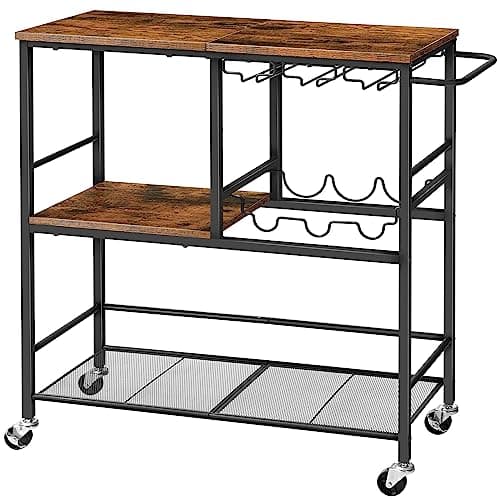
HOOBRO 29.5-inch 3-Tier Serving Cart (BF21TC01)
HOOBRO
The odd one out, and useful because of it: nearly 30 inches long but only 11.2 inches deep. This is the shape for the wall behind a dining chair. Note the shelves are not rated equally — the mesh shelf takes 22 lb, the other two take 33 lb.
- Dimensions
- 29.5 x 11.2 x 34.4 in (L x W x H)
- Weight
- 18.1 lb
- Load, top
- 33 lb static
- Load, middle
- 33 lb static
- Load, mesh shelf
- 22 lb static
Specs compiled from: HOOBRO BF21TC01 published listing, retrieved 2026-09-02.
What is good
- 11.2 inches deep is the shallowest cart in this registry
- Nearly 30 inches of usable length along a wall
- 18.1 lb keeps it movable despite the length
What is not
- The mesh shelf is rated 22 lb, about four full 750 ml bottles
- Three different load ratings on one cart is a compromise, not a feature
- Too shallow for a tray, a decanter and a stack of glasses at once
#ad Disclosure · Price as of October 18, 2026
How these were picked
I have not tested any of these carts. What I did instead: compiled the published specifications from each listing, recorded the figures with their source, checked the footprint against the clearances a real room has, worked out how many standard bottles a stated shelf actually holds, and named the one I would skip. Where two listings for the same cart disagree, the page says so rather than quietly picking one.
Frequently asked
Questions
How much clearance does a bar cart need?
Where should a bar cart go in a living room?
Can a bar cart go in direct sunlight?
Can a bar cart go in a hallway?
Sources
Where the facts on this page came from
Specifications attributed to a retailer listing were read from that listing on the date shown on each product card. Listings change; if you find one that no longer matches what we published, tell us and we will check it and correct the page.
Read next
Related pages
Filed under Sizing. Permanent link: /sizing/where-to-put-a-bar-cart