Section 01 · Basics
What is a bar cart?
A wheeled side table, roughly 32 to 36 inches tall, with two or three open shelves. Everything else is a variation on a trolley.
We earn a commission if you buy through our links, at no extra cost to you. We have not tested these carts. Here is what we did instead.
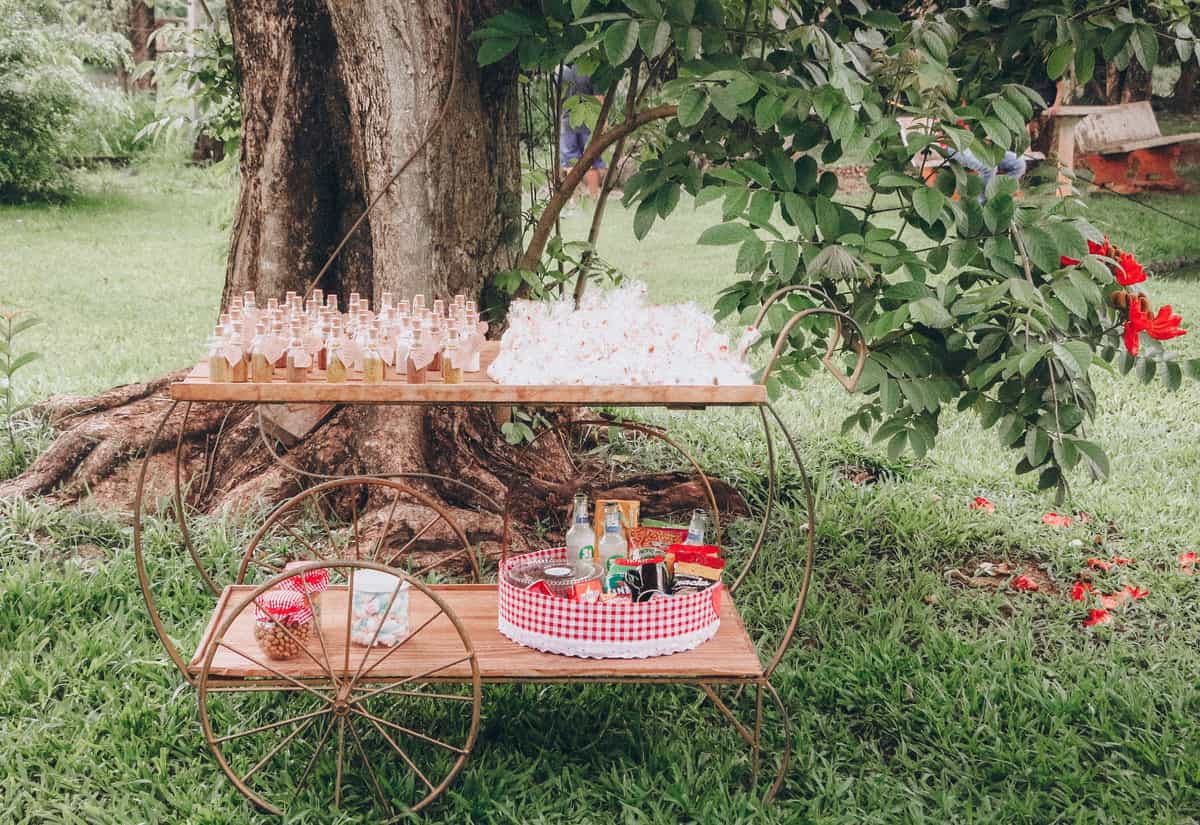
A bar cart is a wheeled side table, roughly 32 to 36 inches tall, with two or three open shelves, used to keep bottles, glassware and bar tools together and movable. That is the whole definition. The wine rack, the mirrored glass, the brass finish and the stem holders are variations on a trolley, and the trolley is the part that decides whether you enjoy owning one.
The dimensions, from real listings
Across the carts in our model library, all figures published by the manufacturers themselves:
- Height: 32.1 to 36.5 inches. That sits above dining table height and below kitchen counter height, which is why a bar cart always looks slightly low next to an island.
- Width: 15 to 33.9 inches. The cluster is 23 to 28 inches; anything under about 19 inches is a narrow-gap cart and anything over 30 needs a wall it can own.
- Depth: 11.2 to 20 inches. This is the number that decides whether a standard 12 by 16 inch tray sits flat.
- Shelf load rating: 33.1 to 66 lb per shelf. About six to twenty full 750 ml bottles.
It is worth knowing that the widely circulated figures do not agree with each other. One published guide describes a standard cart as 28 to 48 inches wide; another describes one as about 24 inches long and 16 deep. Both are presented as the standard, and they differ by roughly a factor of two on the same axis. Our dimensions reference publishes the per-model figures with a source on every row precisely because of that.
What one holds
Less than people expect, and the limit is area rather than weight. A 24 inch shelf fits eight standard 750 ml bottles edge to edge at 2.95 inches diameter. Nobody arranges bottles edge to edge, so call it six. Add a coupe glass at 3.75 inches across the rim and you are at five bottles and two glasses on that shelf.
Weight almost never binds. Six full bottles is roughly 18 lb against a shelf rated anywhere from 33 to 66 lb. If you find yourself worrying about the rating, you have more bottles than shelf.
What it is for
Two things, and they are in tension. The first is logistical: everything needed to pour a drink in one place, so it is one trip rather than three. The second is presentational: a cart announces itself as a bar in a way that a tray on a sideboard does not.
The tension is that the logistical version wants everything on the cart and the presentational version wants very little on it. Most of styling a bar cart is negotiating between those two, and most disappointment with a cart comes from expecting it to do both at once.
Where the object came from
The rolling drinks trolley is a piece of early-twentieth-century entertaining furniture that fell out of fashion with the mid-century cocktail hour and came back with it. That history is the reason two distinct style languages dominate the category today — art deco, which is symmetrical, stepped and heavy, and mid-century modern, which is tapered, light and deliberately a little off-balance. Knowing which one you are aiming at narrows the field faster than any filter.
Is a bar cart worth buying?
If the object needs to move, or you have run out of horizontal surfaces, or you want the thing to read as a bar: yes. If you just want the bottles out of the cupboard, a tray on a console does that today for a fraction of the cost, and what to use instead is an honest walk through the alternatives.
What I would buy
The picks this page points to
These sit here rather than at the top on purpose: the advice above is what decides the choice, and a recommendation only means something once you know what you are choosing between.
The default size
VASAGLE Gold Bar Cart (ULRC100A01)
VASAGLE
The middle of VASAGLE's gold range and the closest thing here to a default cart: 23.6 inches wide, 15 deep, 36.2 tall. The depth is the number that matters. It is the shallowest of the three that still takes a full-size tray flat.
- Dimensions
- 15"D x 23.6"W x 36.2"H
- Weight
- 23.4 lb (10.6 kg)
- Load per shelf
- 66 lb (30 kg) static
- Materials
- Steel frame, mirrored tempered glass
- Shelves
- 3, with wine and glass holders
Specs compiled from: VASAGLE ULRC100A01 published listing, retrieved 2026-09-02.
What is good
- 15 inches deep takes a 12 x 16 inch tray flat with room to spare
- Same 66 lb per-shelf rating as the largest model in the range
- 23.6 inches wide fits the gap beside most three-seat sofas
What is not
- 23.4 lb makes it awkward to reposition one-handed on carpet
- Mirrored shelves need constant wiping to look like the photographs
- Nothing is enclosed, so everything on it is on display whether you want it or not
A first cart
HOOBRO 2-Tier Bar Cart (BF56TC01)
HOOBRO
Two shelves, 16.7 lb, 44 lb rated on each. The lowest-commitment cart in this registry and the one I would put in a rented flat: light enough to move weekly, cheap enough that a scratch is not a crisis.
- Dimensions
- 24.4"L x 13.8"W x 33.1"H
- Weight
- 16.7 lb
- Load per shelf
- 44 lb top, 44 lb bottom
- Materials
- Particleboard and metal frame
- Shelves
- 2
Specs compiled from: HOOBRO BF56TC01 published listing, retrieved 2026-09-02.
What is good
- 16.7 lb moves with one hand, which is the entire point of a cart
- 33.1 inches tall sits close to the middle of the published range
- Two shelves means less to style badly
What is not
- 44 lb a shelf is the lowest rating here, roughly nine full 750 ml bottles
- Particleboard edges are the first thing to fail on a cart that gets knocked
- No wine rack or stem holder, so glasses eat shelf area
How these were picked
I have not tested any of these carts. What I did instead: compiled the published specifications from each listing, recorded the figures with their source, checked the footprint against the clearances a real room has, worked out how many standard bottles a stated shelf actually holds, and named the one I would skip. Where two listings for the same cart disagree, the page says so rather than quietly picking one.
Frequently asked
Questions
What is a bar cart used for?
What are standard bar cart dimensions?
How many bottles does a bar cart hold?
What is another name for a bar cart?
Sources
Where the facts on this page came from
- Standard 750 ml bottle dimensions — Dimensions.com
- Standard home bar dimensions — UpgradedHome
- Bar cart height guidance — V Modern Furniture
Specifications attributed to a retailer listing were read from that listing on the date shown on each product card. Listings change; if you find one that no longer matches what we published, tell us and we will check it and correct the page.
Read next
Related pages
Filed under Basics. Permanent link: /basics/what-is-a-bar-cart