Section 06 · Styling
Bar cart ideas for living rooms
The living room is where most carts end up and where most of them stop being used. Five placements, with the clearance math for each.
We earn a commission if you buy through our links, at no extra cost to you. We have not tested these carts. Here is what we did instead.
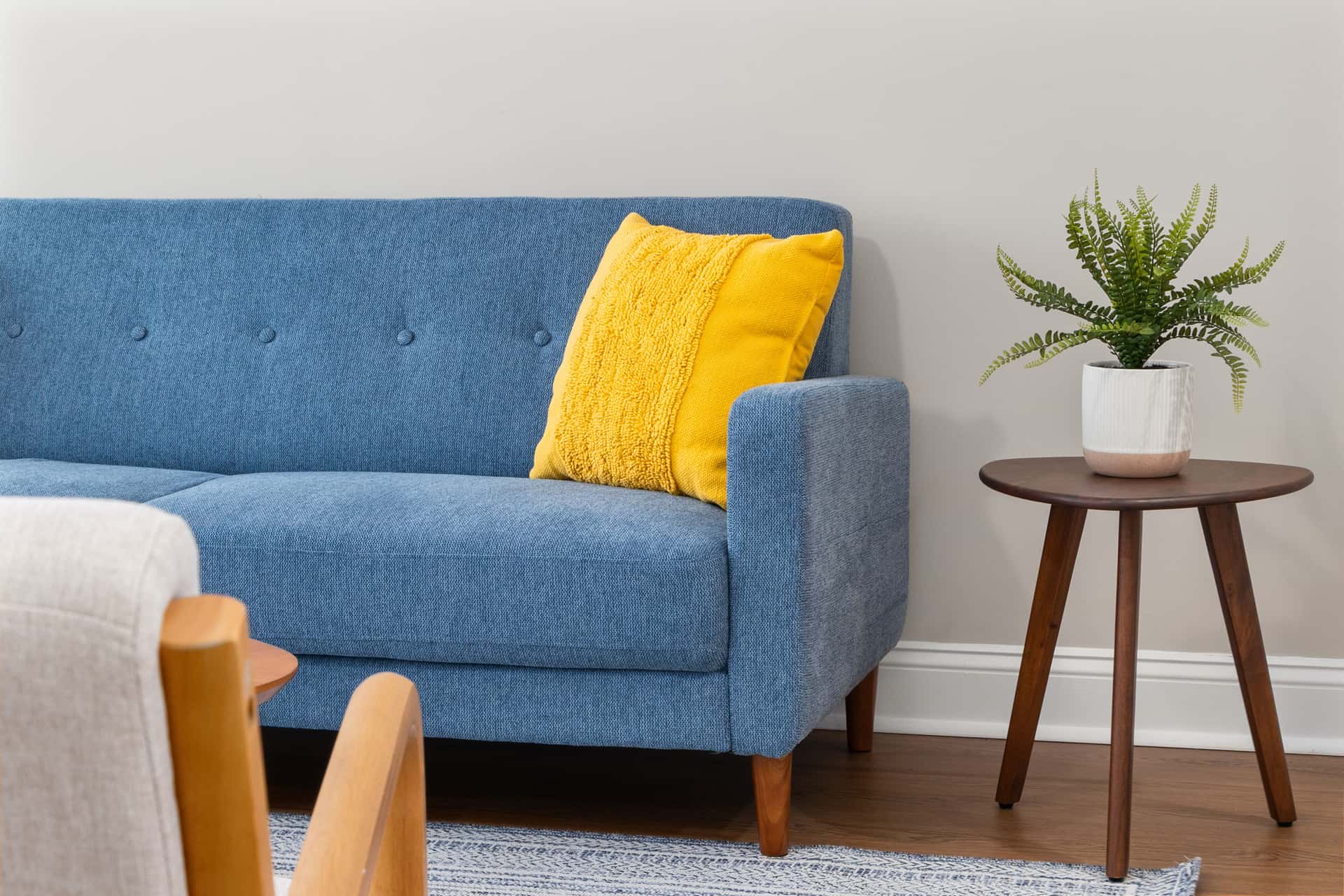
A bar cart in a living room fails in a specific and predictable way. It goes against the wall furthest from the seating, because that is where the empty wall is; from there it is a five-step journey to reach; and within a month the drinks are being made in the kitchen again and the cart is holding a plant, a candle and a stack of magazines.
Everything below is an attempt to avoid that. The organizing principle is simple: a cart earns its place by being closer to the seating than the kitchen is. If it is not, it is a console table with wheels, and there are cheaper console tables.
The two numbers every placement needs
About 18 inches in front. That is the space one person needs to stand square to the cart and pour without stepping sideways. Less than that and you will use the cart at an angle, and using a cart at an angle is how the back row gets knocked over.
About 30 to 36 inches for a walkway. If the cart sits along a route people take through the room, the remaining gap has to still be a corridor. Take the width of the route, subtract the cart's depth, and see what is left. A 15 inch deep cart in a 48 inch gap leaves 33 inches, which works. The same cart in a 40 inch gap leaves 25, which is a squeeze past, and people stop squeezing past things.
Those two numbers eliminate most placements before you move any furniture. The fuller treatment, including rooms where the answer is that there is no space, is on where to put a bar cart.
Five placements that work
1. Beside the sofa arm, replacing the side table. The best placement in most rooms and the one people arrive at last. The cart is within reach of someone sitting down, it is doing the side table's job as well as its own, and the room loses no furniture. What it needs is width: most three-seat sofas leave 20 to 30 inches beside the arm. The Nathan James Hallie at 27 inches wide and 17 deep fits that gap and is 14 lb, so it comes out easily when you want it somewhere else.
2. Behind the sofa, if the sofa floats. If the seating is not against a wall, the strip behind it is usually dead space, and a cart there is invisible from the seated position and reachable by standing up and turning round. It wants to be shallow — the strip is rarely more than about 14 inches before it becomes a walkway problem. This is the placement where a long, shallow cart beats a square one.
3. Flanking a fireplace or a chimney breast. The alcove beside a chimney breast is the most reliably under-used rectangle in a living room, and it is usually 20 to 40 inches wide. A cart there reads as deliberate rather than parked. Measure at the narrowest point: skirting boards and the breast itself rarely give you the full opening. If the alcove is genuinely tight, the field is on tall, narrow bar carts.
4. Under a window, below the sill. Underused because people assume it blocks the light, and it usually does not — a cart is 32 to 36 inches tall and most sills are higher than that. Check yours, because a cart standing proud of a sill looks like a mistake and a cart sitting just under it looks built in. This placement also gets the cart the best light in the room, which is worth something if there is glassware on it.
5. As the end of a run. If the room already has a bookcase, a sideboard or a media unit along one wall, a cart of similar height at the end of it extends the line rather than interrupting it. The height match matters more than the finish match here: 34 inches next to 34 inches reads as one composition, and 36 next to 30 reads as two objects that were put there separately.
What actually goes on it in a living room
Less than you think, and the reason is sightlines. A living room cart is seen from a seated position across the room, and from there a crowded shelf reads as clutter rather than as a bar. The rule that works is one tray, one tall thing, one living thing, and then stop.
The tray is the working set — the two bottles you actually pour and the tool you actually reach for. It also lets you carry the whole arrangement to a coffee table, which is the single most useful thing a living room cart does. The acacia tray here publishes an 11 lb limit, which is about four full bottles; most trays publish no limit at all, and the comparison is on bar cart trays.
The tall thing — a decanter, a bottle with a good shape, a stemmed glass — stops the cart reading as a flat plane. Height is what makes an arrangement look composed from across the room.
The living thing is a small plant or cut stems, on the lower shelf rather than the top, so it does not compete with the working set. The full method, including why odd numbers work, is on how to style a bar cart and bar cart decor.
Matching it to the room, without matching it to the sofa
Match metal to metal. Walk into the room and find the metal that already appears most — door handles, lamp bases, the curtain pole, picture frames — and let the cart frame be that. A gold cart in a room of brushed nickel does not read as a bold choice; it reads as an accident.
Do not match the cart to the upholstery. Fabric and metal do not relate to each other, and matching them is how a room ends up looking like a showroom display. The full method is on how to choose a bar cart finish.
One living-room-specific point: dark frames disappear and light frames announce themselves. In a room where you did not really want a cart to be a feature — because the television is already the feature — a black frame reads as structure rather than as an object. In a room with a bare wall that needs something, gold or brass does the opposite.
The four carts here, and which room each suits
Beside the sofa (Nathan James Hallie). 27 by 17 inches, 14 lb, 66 lb capacity, mid-century. The best weight-to-size ratio on the site, which is what you want for the placement that involves moving it most. 36 inches tall reads high next to a low sofa, which is the trade.
The default (VASAGLE ULRC100A01). 23.6 by 15 inches, 66 lb a shelf, gold and mirrored glass. Fifteen inches of depth is the tray threshold, and 23.6 inches fits the gap beside most three-seat sofas. If you have no reason to buy something else, this is the one.
If you actually mix drinks (Nathan James Sally). 28 by 19 inches — the largest top surface in our library — on a 34 inch frame. Work surface is the specification that matters if you build drinks rather than pour them, and 19 inches of depth is the most here. It will not tuck anywhere, which is the cost.
If it is mostly wine (HOOBRO BF02TC01). 25.2 by 15.7 inches, 55 lb a shelf, with a horizontal wine rack built in. Bottles stored on their side take a fraction of the shelf area that bottles standing up do, which in a living room is the difference between a composed cart and a crowded one.
Before you move any furniture
Put a chair where the cart would go and live with it for a day. If you walk round it more than twice, that is the wrong spot, and no amount of styling fixes a cart in a walkway.
Then measure: the gap at its narrowest, about 18 inches of standing room in front, and the remaining walkway. Then check the cart's published depth against the strip you have — depths across our library run from 11.2 to 20 inches, and that single figure decides more living-room placements than width does. Everything is sourced on the dimensions reference.
What I would buy
The picks this page points to
These sit here rather than at the top on purpose: the advice above is what decides the choice, and a recommendation only means something once you know what you are choosing between.
Mid-century rooms
Nathan James Hallie Rolling Bar Cart
Nathan James
27 inches wide, 17 deep, 36 tall, and only 14 lb — an unusually good ratio. It is the mid-century-styled cart I would actually buy, mostly because 17 inches of depth is generous and the whole thing still lifts with one hand.
- Dimensions
- 17"D x 27"W x 36"H
- Weight
- 14 lb
- Weight capacity
- 66 lb
- Style
- Mid-century modern, two tiers
- Height
- 36", the tall end of the range
Specs compiled from: Nathan James Hallie published listing, retrieved 2026-09-02.
What is good
- 17 inches deep takes a large tray and still leaves an edge
- 14 lb for a 27 inch cart is the best weight-to-size ratio here
- 66 lb capacity despite the low frame weight
What is not
- 36 inches tall reads high next to a low mid-century sofa
- Two tiers only, so bottle capacity is limited by area rather than rating
- Light frames flex slightly when pushed over a threshold
The default size
VASAGLE Gold Bar Cart (ULRC100A01)
VASAGLE
The middle of VASAGLE's gold range and the closest thing here to a default cart: 23.6 inches wide, 15 deep, 36.2 tall. The depth is the number that matters. It is the shallowest of the three that still takes a full-size tray flat.
- Dimensions
- 15"D x 23.6"W x 36.2"H
- Weight
- 23.4 lb (10.6 kg)
- Load per shelf
- 66 lb (30 kg) static
- Materials
- Steel frame, mirrored tempered glass
- Shelves
- 3, with wine and glass holders
Specs compiled from: VASAGLE ULRC100A01 published listing, retrieved 2026-09-02.
What is good
- 15 inches deep takes a 12 x 16 inch tray flat with room to spare
- Same 66 lb per-shelf rating as the largest model in the range
- 23.6 inches wide fits the gap beside most three-seat sofas
What is not
- 23.4 lb makes it awkward to reposition one-handed on carpet
- Mirrored shelves need constant wiping to look like the photographs
- Nothing is enclosed, so everything on it is on display whether you want it or not
The widest surface
Nathan James Sally Rolling Bar Cart
Nathan James
28 inches wide and 19 deep, the largest top surface in this registry, on a 34 inch frame that stays inside normal serving height. If you actually mix drinks rather than pour them, work surface is the spec that matters.
- Dimensions
- 19"D x 28"W x 34"H
- Weight
- 24 lb
- Weight capacity
- 66 lb
- Materials
- Black metal frame, glass shelves
- Tiers
- 2
Specs compiled from: Nathan James Sally published listing, retrieved 2026-09-02.
What is good
- 19 inches deep is the most working room of anything here
- 34 inches tall is a comfortable height to build a drink on
- 66 lb capacity on a 24 lb cart
What is not
- 28 by 19 inches is a real footprint, and it will not tuck anywhere
- Two tiers, so storage lives on the floor shelf or nowhere
- A dark frame plus glass shows dust more than a wood finish
Wine, specifically
HOOBRO Bar Cart with Wine Rack (BF02TC01)
HOOBRO
25.2 by 15.7 inches with a built-in wine rack and 55 lb a shelf. If most of what you own is wine rather than spirits, a rack that holds bottles horizontally is worth more shelf area than any amount of open glass.
- Dimensions
- 25.2"L x 15.7"W x 33.3"H
- Weight
- 26.5 lb
- Load per shelf
- 55 lb static
- Materials
- Particleboard and metal frame
- Storage
- Wine rack plus shelves, adjustable feet
Specs compiled from: HOOBRO BF02TC01 published listing, retrieved 2026-09-02.
What is good
- 15.7 inches deep takes a full-size tray flat
- Horizontal wine storage keeps corks wet without a separate rack
- Adjustable feet, which matters on old floors
What is not
- 26.5 lb, so it stays where you put it
- The rack is fixed geometry: bottles that are not standard 750 ml shapes fit badly
- Rustic wood-and-black styling narrows the rooms it suits
The one that carries
Abawi Nexus Acacia Serving Tray, 17 x 13 in
Abawi Nexus
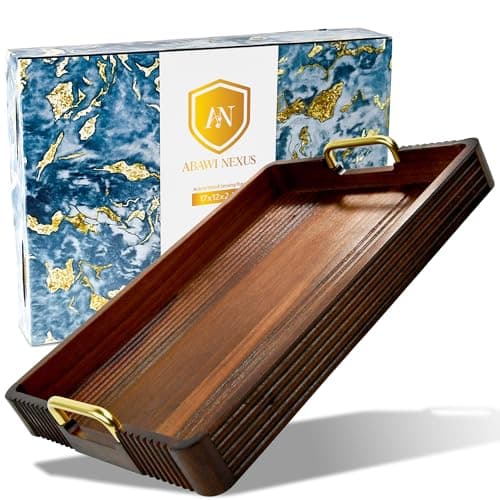
Acacia with metal handles, 17 by 13 inches, and — rarest of all in this category — a published weight limit of 11 lb. Eleven pounds is roughly four full bottles, which is the only tray here that can honestly be described as one you carry rather than one you arrange.
- Dimensions
- 17"L x 13"W x 2"H
- Weight
- 1.11 kg (about 2.4 lb)
- Maximum load
- 11 lb
- Materials
- Acacia wood, metal handles
- Finish
- Dark acacia with gold handles
Specs compiled from: Abawi Nexus acacia serving tray published listing, retrieved 2026-09-06.
What is good
- 11 lb published limit, about four full 750 ml bottles
- Acacia takes a knock and a spill better than any board tray here
- 2 inch sides, high enough to stop a glass sliding off in transit
What is not
- 17 by 13 inches will not sit flat on a cart shallower than about 14 inches
- Wood needs occasional oiling if it lives somewhere sunny
- The gold handles are a style commitment, not a neutral choice
#ad Disclosure · Price as of October 17, 2026
How these were picked
I have not tested any of these carts. What I did instead: compiled the published specifications from each listing, recorded the figures with their source, checked the footprint against the clearances a real room has, worked out how many standard bottles a stated shelf actually holds, and named the one I would skip. Where two listings for the same cart disagree, the page says so rather than quietly picking one.
Frequently asked
Questions
Where should a bar cart go in a living room?
How much space does a bar cart need in a living room?
What should I put on a living room bar cart?
Should the bar cart match my sofa?
Sources
Where the facts on this page came from
Specifications attributed to a retailer listing were read from that listing on the date shown on each product card. Listings change; if you find one that no longer matches what we published, tell us and we will check it and correct the page.
Read next
Related pages
Filed under Styling. Permanent link: /styling/bar-cart-ideas-for-living-rooms