Section 06 · Styling
How to style a bar cart
One tray, three groups, three heights, and a gap you leave on purpose. Styling a cart is editing, and editing is mostly removing things.
We earn a commission if you buy through our links, at no extra cost to you. We have not tested these carts. Here is what we did instead.
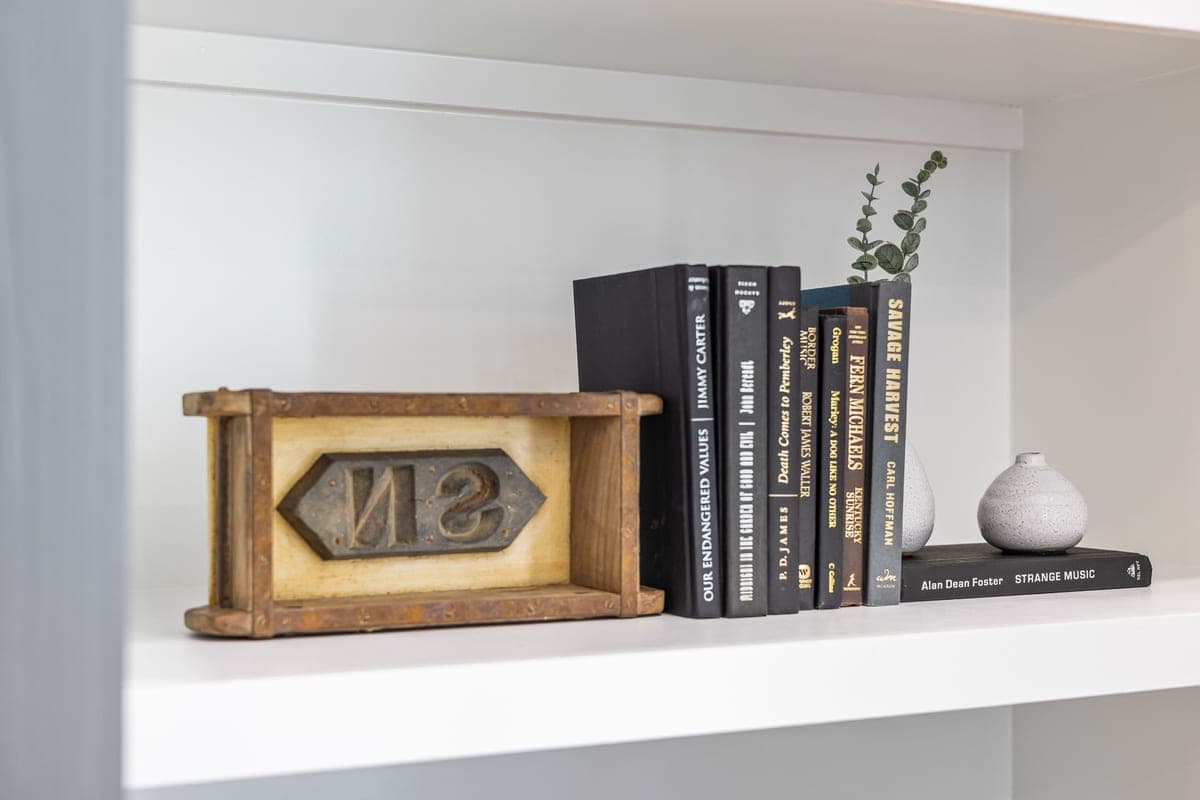
The carts that look composed in photographs are not carrying more objects than yours. They are carrying fewer, in three groups, at three heights, with one tray holding the arrangement together. That is the whole method, and the rest of this page is why each part of it works.
Step one: take everything off
Styling around objects already in place reproduces the arrangement you already dislike. Clear the cart completely, wipe it, and start from nothing. This takes two minutes and it is the step people skip.
Step two: the tray goes down first
A tray is not decoration. It is a boundary: it groups six bottles into one object, it catches drips, and it lets you lift the entire arrangement to clean underneath. It is also the cheapest thing that makes a cart look deliberate.
The constraint is depth. A standard tray is about 12 by 16 inches and needs roughly 15 inches of cart depth to sit flat. Six of the sixteen carts in our dimensions table are shallower than that. If yours is one of them, use a smaller tray or a round one — the grouping effect matters, the size does not.
Step three: three groups
Not six objects. Three groups:
- The bottles, on the tray. Four to six, tallest at the back.
- The glassware, together, in one place. Eight glasses in two shapes.
- One accent group — the ice bucket and a small plant, or two books and a candle. One group, not three separate objects.
Three groups read as composed. Six loose objects read as accumulation, and the difference is entirely in whether things are touching.
Step four: three heights within each group
This is the rule that makes the biggest visible difference and the one people find least intuitive. Within each group you want something tall, something mid-height and something low, so the eye has somewhere to travel.
Bottles do this naturally — a 11.8 inch bottle beside a short bitters bottle beside a 4 inch rocks glass is already three heights. Glassware does not: eight glasses of the same height is a flat line, which is why a stack of two books under a couple of glasses works so well.
Step five: odd numbers, and leave a gap
Three groups beats four. Three bottles in a row beats four. This is a convention rather than a law, and the reason it works is that even arrangements read as symmetrical and symmetry reads as formal — which is right for a deco cart and wrong for almost everything else.
The gap matters more. Empty space on a shelf is not wasted; it is what tells a viewer the arrangement was chosen. A fully loaded cart, however carefully arranged, reads as storage. Aim for about a third of the top shelf clear — which is also the landing space you need for a glass while you pour.
What to add if it still looks sparse
In order of how much they help:
- Something living. One small trailing plant. It adds an organic line to a cart made entirely of straight ones.
- Something with a label. A cocktail book lying flat, spine out. Two at most.
- Something reflective. A metal bucket or a decanter catches light and stops a shelf reading flat.
- Something on the wall above. Genuinely the biggest single improvement to most carts, and it is not on the cart at all — see what to put above a bar cart.
The deco and mid-century variants
The method above is the general case. Two style-specific adjustments:
Deco inverts the odd-number rule. Deco styling is symmetrical and paired: two matched objects flanking a central one, centered on the shelf. See art deco bar carts.
Mid-century is the odd-number rule at full strength, with warm metals rather than chrome and a bottle-forward rather than glassware-forward arrangement. See mid-century modern bar carts.
What I would buy
The picks this page points to
These sit here rather than at the top on purpose: the advice above is what decides the choice, and a recommendation only means something once you know what you are choosing between.
Shorter shelf gaps
Mr. Ice Bucket Metallic Deco, 3 Quart
Mr. Ice Bucket
The same 3 quarts in a shorter body: published at 7.75 by 7.75 by 8 inches. Two and a half inches shorter than the VIVOHOME is often exactly the margin that lets it live where you want it.
- Capacity
- 3 quarts
- Dimensions
- 7.75"W x 7.75"D x 8"H
- Construction
- Double-walled
- Style
- Metallic deco
- Made in
- USA, per the listing
Specs compiled from: Mr. Ice Bucket 529-1 published listing, retrieved 2026-09-02.
What is good
- 8" tall clears far more shelf gaps than a 10.4" bucket
- The same 3 quart capacity in a squatter body
- Deco styling suits a brass or gold frame
What is not
- No tongs listed, so budget for those separately
- Wide-and-short still costs 7.75 inches of shelf depth
- Metallic finishes scuff where the lid seats
Buying four, not twelve
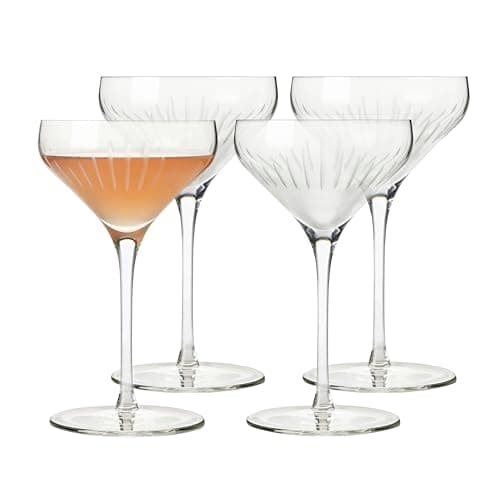
Libbey Signature Greenwich Coupe, 8 oz (set of 4)
Libbey
The same idea as the Perception in a set of four rather than a case of twelve, which is what a home cart actually needs. Published at 3.9 by 3.9 by 6.5 inches, so plan for a 6.5 inch shelf gap.
- Capacity
- 8 oz
- Dimensions
- 3.9 x 3.9 x 6.5 in
- Sold as
- Set of 4
- Material
- Lead-free glass
- Care
- Dishwasher safe
Specs compiled from: Libbey Signature Greenwich published listing, retrieved 2026-09-02.
What is good
- Four is the right number for a two-shelf cart
- 8 oz is the useful modern coupe size
- Widely stocked, so a breakage is replaceable
What is not
- 6.5 inches tall is taller than the case-packed Perception
- Sets of four cost more per glass than a case
- A wide bowl means the same spill risk as any coupe
#ad Disclosure · Price as of October 18, 2026
How these were picked
I have not tested any of these carts. What I did instead: compiled the published specifications from each listing, recorded the figures with their source, checked the footprint against the clearances a real room has, worked out how many standard bottles a stated shelf actually holds, and named the one I would skip. Where two listings for the same cart disagree, the page says so rather than quietly picking one.
Frequently asked
Questions
How do you style a bar cart?
How many bottles should be visible on a styled bar cart?
Does a bar cart need a tray?
Why does my bar cart look cluttered?
Sources
Where the facts on this page came from
Specifications attributed to a retailer listing were read from that listing on the date shown on each product card. Listings change; if you find one that no longer matches what we published, tell us and we will check it and correct the page.
Read next
Related pages
Filed under Styling. Permanent link: /styling/how-to-style-a-bar-cart