Section 03 · Sizing
What actually fits in a corner
Search for a corner bar cart and you get cabinets. Here is the geometry a corner really imposes, and the four shapes that answer it.
We earn a commission if you buy through our links, at no extra cost to you. We have not tested these carts. Here is what we did instead.
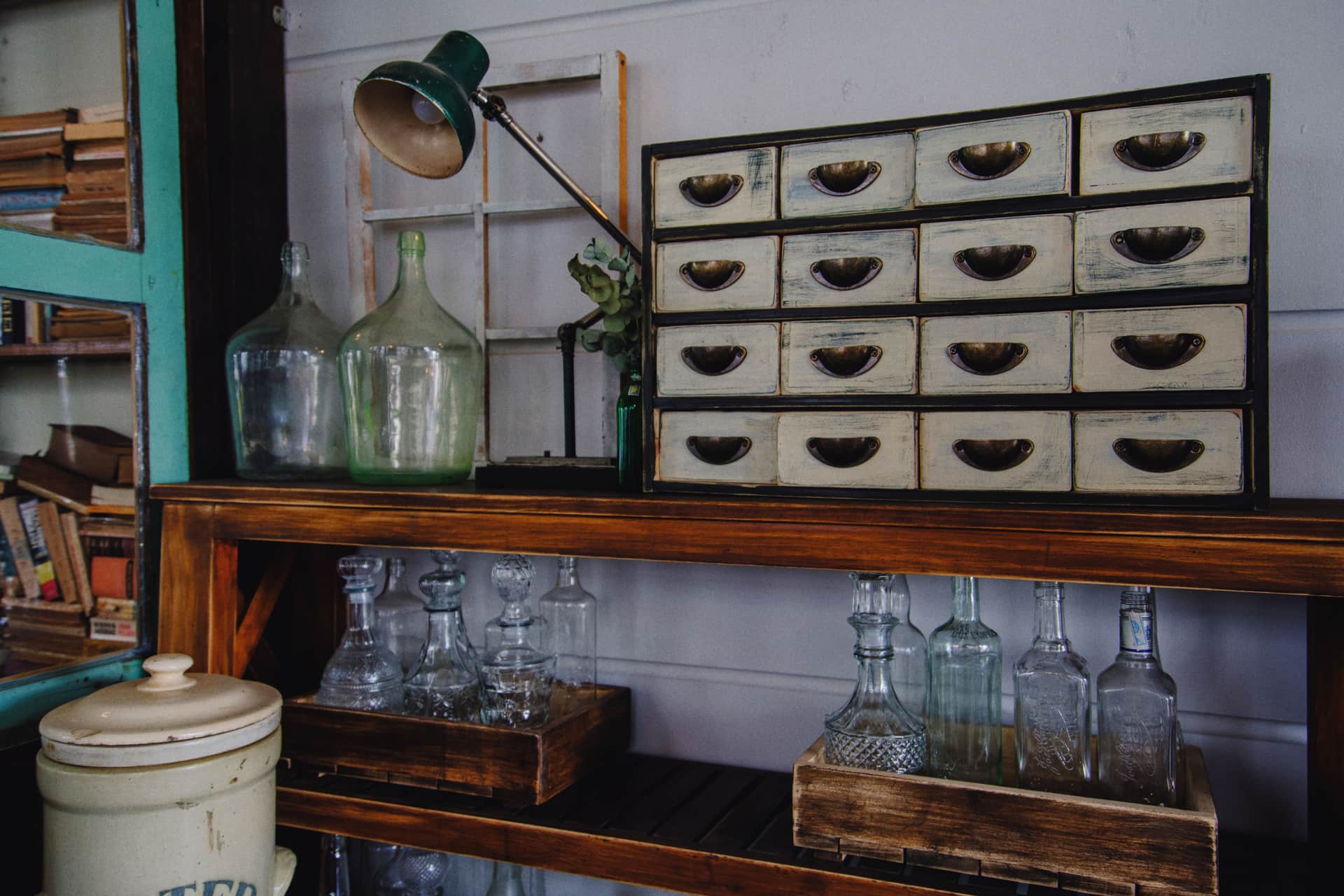
There is almost no such thing as a corner bar cart. Search the term and what comes back is corner bar cabinets — triangular units, usually with a door, that stand in a corner and do not move. They are a real product and sometimes the right one, but they are not carts, and the difference is the whole reason anyone wanted a cart.
That is worth stating up front rather than working around, because the useful question is not "which cart is corner-shaped". It is "what does a corner actually do to a rectangular object", and once you have the geometry the shortlist writes itself.
What a corner does to a rectangle
Push a rectangular cart into a 90 degree corner and one of three things happens.
You put it square against one wall. The cart is fully usable and the corner is not: there is a triangular dead zone behind the far end of it. This is fine. It is also not really using the corner, which is what you came for.
You put it diagonally across the corner. The front face points into the room, which looks deliberate and reaches both walls. The cost is floor, and it is larger than people expect: a 24 by 15 inch cart set at 45 degrees reaches about 28 inches along each wall and its furthest corner stands about 28 inches clear of each one. Square against a wall the same cart projects 15 inches. Turning it diagonally pushes it nearly twice as far into the room.
You buy something built to the corner. A triangular cabinet wastes no floor at all and cannot come to the sofa, because it has no wheels and, at these depths, no sensible way to have them.
There is no fourth option. Nobody makes a wheeled triangular cart in any quantity, and the reason is mechanical: a triangle on casters has its weight over one narrow edge and tips toward the open face when you load the shelf you can actually reach.
The four shapes that work, in order
Round. The best answer for most corners and the one people least expect. A circle has no corners to catch a hip, it looks correct at any angle — a rectangle set diagonally always looks slightly wrong from one side — and it reads as deliberate rather than as furniture that did not fit. The Nathan James Sage is 23 inches across, 12 lb and rated to 66 lb, which is a high figure for the lightest cart in this registry. What you give up is area: 23 inches across a circle is meaningfully less usable surface than 23 inches across a rectangle, and a tray will not sit flush on it.
Very narrow. If the corner is formed by a cabinet and a wall rather than by two open walls, the answer is usually a slot rather than a triangle. The MAHANCRIS RCJ40B01 publishes 9.4 inches on its short axis, which will go where nothing else will. Everything else about it is a compromise, and the full narrow field is on tall, narrow bar carts.
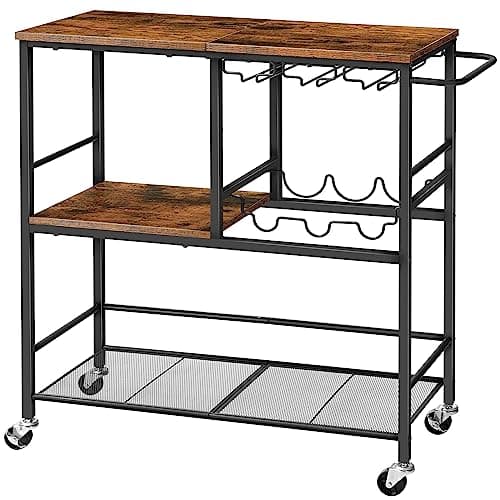
Long and shallow, along one wall. The underrated answer. The HOOBRO BF21TC01 is 29.5 inches long and 11.2 inches deep, which means it runs into the corner along one wall and takes almost no walkway doing it. The corner itself stays empty, but the corner was never the useful part — the wall leading to it was.
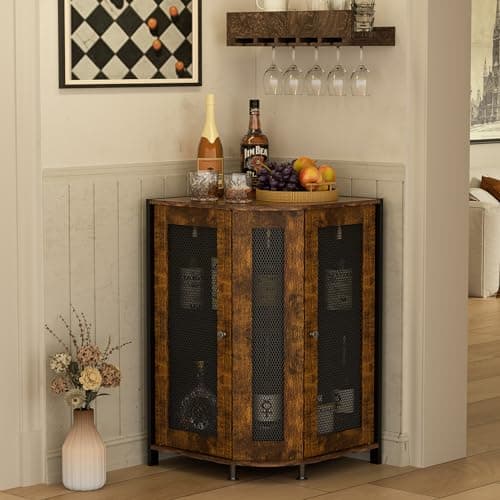
An actual corner cabinet. If the corner is genuinely the only place the drinks can live and the room has no wall to spare, the JKsmart corner cabinet is what the category actually offers: 18.5 inches on each wall, 30.3 tall, an open display shelf over a closed door. It publishes no load rating and it has no wheels. Buying it means deciding that the drinks stay in the corner permanently, which is a real decision and not obviously the wrong one.
The arithmetic, worked
Set a cart diagonally across a corner and the distance it reaches along each wall is roughly its width plus its depth, divided by 1.41. For a 24 by 15 inch cart that is about 28 inches along each wall, and the far corner of the cart sits about 28 inches clear of each wall too. The back edge itself only touches the walls about 17 inches out from the corner, which is why a diagonal cart looks smaller in a plan drawing than it feels in the room.
Set the same cart square against one wall and it occupies 24 inches of that wall and projects 15 inches. Same object, and turning it diagonally pushes it nearly twice as far into the room. If the room is tight — and a room where the corner is the only spot usually is — square against the wall is the placement that works, and then you are not shopping for a corner cart at all. You are shopping for a small bar cart.
One number does not change with placement: the roughly 18 inches of standing room you need in front of the cart to pour without stepping sideways. In a corner that space is shared between two walls, which is another argument for round — with no corners on the cart, you can approach it from a wider arc.
The case against forcing it
Corners are where furniture goes when a room has run out of ideas, and a bar cart in a corner has a specific failure mode: it stops being used. A cart earns its wheels by coming to where people are sitting, and a cart wedged diagonally into a corner behind an armchair is a shelf that has to be excavated. If the corner you are thinking of is behind something, the honest answer is that the drinks want a different wall.
The alternatives, if the corner really is the only free floor: a floating shelf above the corner, which uses the dead vertical space instead of the dead floor; or a bar cabinet, which accepts that the drinks are furniture now. Both are covered honestly elsewhere on the site, including the cases where they beat a cart.
Before you order
Measure both walls out from the corner, not just one. Then decide, before you shop, whether this thing is going to move. If it moves, buy round or narrow and put it square against a wall. If it does not move, buy the cabinet and stop paying for casters you will never release.
Then check the usual figures: a published load rating if there is one, the shelf gap against a 750 ml bottle at about 11.8 inches tall, and the height against the 32 to 36 inch band that how tall a bar cart should be works through. The cabinet here is 30.3 inches, below that band, which is comfortable to reach into and low to pour on.
What I would buy
The picks this page points to
These sit here rather than at the top on purpose: the advice above is what decides the choice, and a recommendation only means something once you know what you are choosing between.
Corners and traffic
Nathan James Sage Round Rolling Cart
Nathan James
The round one, and the case for round is practical rather than decorative: no corners to catch a hip in a narrow room. 12 lb, 66 lb capacity, and the tallest cart here at 36.5 inches.
- Dimensions
- 20"D x 23"W x 36.5"H
- Weight
- 12 lb
- Weight capacity
- 66 lb
- Shape
- Round, two tiers
- Style
- Mid-century, retro
Specs compiled from: Nathan James Sage published listing, retrieved 2026-09-02.
What is good
- No corners, which is worth more than it sounds in a walkway
- 12 lb is among the lightest carts in this registry
- 66 lb capacity despite that weight
What is not
- 36.5 inches is the tallest here and it looks it
- Round shelves waste area at the edges, and a tray will not sit flush
- 23 inches across a circle is less usable surface than 23 inches across a rectangle
Odd narrow slots
MAHANCRIS 3-Tier Glass Bar Cart (RCJ40B01)
MAHANCRIS
A genuinely strange footprint, and a good example of why you measure rather than trust a title. The listing publishes 16.9 inches deep by 9.4 inches wide — narrower than it is deep, the opposite of most carts. Read it as a tall, thin unit for a slot beside a cabinet.
- Dimensions
- 16.9"D x 9.4"W x 32.3"H (as published)
- Weight
- 13.2 lb
- Load per shelf
- 44 lb static
- Materials
- Metal frame, tempered glass shelves
- Shelves
- 3
Specs compiled from: MAHANCRIS RCJ40B01 published listing, retrieved 2026-09-02.
What is good
- The narrowest published width in this registry at 9.4 inches
- 13.2 lb, so it lifts rather than rolls when you need it out of the way
- Tempered glass shelves wipe clean in a way particleboard does not
What is not
- The listing's own width and depth labels are ambiguous, so measure your slot both ways
- 9.4 inches of width holds a row of bottles and essentially nothing else
- 44 lb a shelf on a cart this narrow means keeping the weight low
An actual corner
JKsmart 3-Tier Corner Bar Cabinet
JKsmart
Not a cart, and that is the point: it is a triangular 18.5 inch cabinet built to sit in a 90 degree corner, with an open display shelf above a closed door. If the corner is genuinely the only place the drinks can live, this is the shape that fits it.
- Dimensions
- 18.5"D x 18.5"W x 30.3"H
- Load per shelf
- Not published
- Materials
- Engineered wood, iron frame
- Storage
- Open shelves plus a closed cabinet
- Wheels
- None — it stays where you put it
Specs compiled from: JKsmart 3-tier corner bar cabinet published listing, retrieved 2026-09-06.
What is good
- Built to a corner rather than pushed into one, so it wastes no floor
- A closed door hides the part of a home bar nobody wants displayed
- 30.3 inches tall keeps the top surface usable as a pouring station
What is not
- No wheels, so it is furniture rather than a cart and cannot come to the room
- No published load rating on any shelf
- 18.5 inches across a triangle is far less usable area than 18.5 inches across a rectangle
#ad Disclosure · Price as of October 17, 2026
Long, shallow walls
HOOBRO 29.5-inch 3-Tier Serving Cart (BF21TC01)
HOOBRO
The odd one out, and useful because of it: nearly 30 inches long but only 11.2 inches deep. This is the shape for the wall behind a dining chair. Note the shelves are not rated equally — the mesh shelf takes 22 lb, the other two take 33 lb.
- Dimensions
- 29.5 x 11.2 x 34.4 in (L x W x H)
- Weight
- 18.1 lb
- Load, top
- 33 lb static
- Load, middle
- 33 lb static
- Load, mesh shelf
- 22 lb static
Specs compiled from: HOOBRO BF21TC01 published listing, retrieved 2026-09-02.
What is good
- 11.2 inches deep is the shallowest cart in this registry
- Nearly 30 inches of usable length along a wall
- 18.1 lb keeps it movable despite the length
What is not
- The mesh shelf is rated 22 lb, about four full 750 ml bottles
- Three different load ratings on one cart is a compromise, not a feature
- Too shallow for a tray, a decanter and a stack of glasses at once
#ad Disclosure · Price as of October 17, 2026
The lightest three-tier
VASAGLE Barnet Narrow Bar Cart (ULRC190K101)
VASAGLE
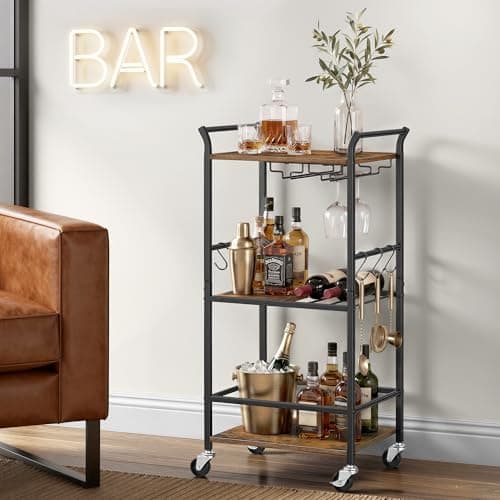
10.6 lb for three tiers, a wine rack and stem holders. That is one of the two lightest carts in this registry, and light is the whole argument for a narrow cart: the reason it lives in a gap is that you can lift it out of the gap.
- Dimensions
- 17.5"D x 12.6"W x 33.7"H
- Weight
- 10.6 lb
- Load per shelf
- Not published
- Materials
- Particleboard shelves, steel frame
- Storage
- Wine rack and stem holders
Specs compiled from: VASAGLE Barnet ULRC190K101 published listing, retrieved 2026-09-06.
What is good
- 10.6 lb is among the lightest carts in this registry, and it moves one-handed
- 12.6 inches on the short axis clears most gaps beside a sofa arm
- Three tiers plus a rack at the bottom of the price range
What is not
- No published load rating, which on a 10.6 lb frame is the figure you most want
- Particleboard swells permanently once a spill reaches a cut edge
- A very light cart flexes crossing a threshold, which is when glass walks off
#ad Disclosure · Price as of October 17, 2026
How these were picked
I have not tested any of these carts. What I did instead: compiled the published specifications from each listing, recorded the figures with their source, checked the footprint against the clearances a real room has, worked out how many standard bottles a stated shelf actually holds, and named the one I would skip. Where two listings for the same cart disagree, the page says so rather than quietly picking one.
Frequently asked
Questions
Do corner bar carts exist?
What shape of bar cart is best for a corner?
How much floor does a cart set diagonally in a corner use?
Corner cabinet or corner cart?
Sources
Where the facts on this page came from
Specifications attributed to a retailer listing were read from that listing on the date shown on each product card. Listings change; if you find one that no longer matches what we published, tell us and we will check it and correct the page.
Read next
Related pages
Filed under Sizing. Permanent link: /sizing/corner-bar-carts