Section 01 · Basics
Are bar carts out of style?
The object is not dated. One specific version of it is. Here is which, why, and how to buy the part that outlives the trend.
We earn a commission if you buy through our links, at no extra cost to you. We have not tested these carts. Here is what we did instead.
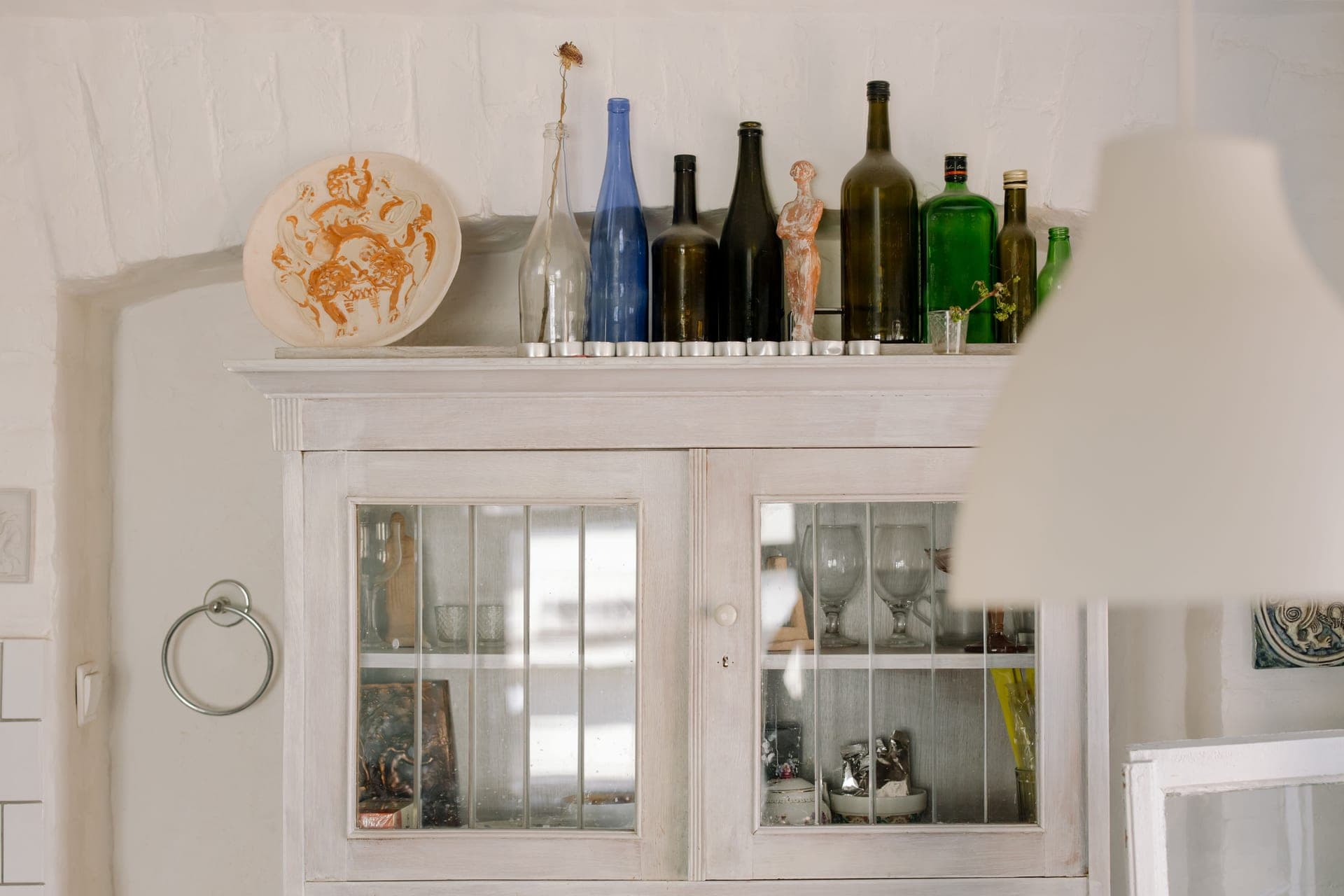
Short answer: no, but a specific version of the bar cart is. The gold frame with mirrored glass shelves, styled with a pineapple ice bucket, a brass cocktail shaker nobody used and a small stack of coffee-table books — that arrangement peaked around 2015 and now reads as precisely dated as an Edison bulb.
The trolley itself is not a trend. It is a wheeled side table with two or three open shelves, it has existed as a piece of furniture since the 1920s, and it solves a problem that has not changed: the bottles are in a kitchen cupboard, the glasses are somewhere else, and pouring anyone a drink means three journeys.
The honest way to answer this question is to separate what dated from what did not, because they are different things and only one of them is a purchase decision.
What actually dated
The styling, not the object. What went out of fashion was a particular arrangement — the highly composed, largely decorative cart that was photographed more than it was used. The tell was that nothing on it had been opened. A cart with three unopened bottles, a shaker still in its packaging shine and a decorative pineapple was a still life, and still lifes date faster than furniture.
Mirrored glass, somewhat. Mirrored shelves are the single most identifiable element of the 2015 cart, and they are also genuinely the highest-maintenance surface in the category — every fingerprint and every water ring shows. Clear glass has most of the visual effect and a fraction of the wiping, and wood-look has neither problem. The full comparison is on glass versus mirrored shelves.
The pineapple. Genuinely, and it stands in for a whole category of ornament bought to sit on a cart rather than to be used. The things on a cart now tend to be things that get opened.
What did not date: gold as a finish. Gold on a cart is still by some distance the most searched finish in this category, at a level that has not collapsed. That surprises people who assume gold was the trend. Gold was the finish the trend used; the finish outlived it. Our gold roundup takes it on its own terms.
What replaced it, and what that tells you
Three shifts, and each of them is a shift toward use rather than display.
Warmer materials. Wood and wood-look shelves on black or bronze frames have taken a great deal of the ground that gold-and-mirror held. They photograph less dramatically and they hide a water ring, which is the trade a cart that gets used actually wants. The materials, and how to tell them apart, are on the wood cart page.
The cart that is not a bar. Coffee carts, tea carts and non-alcoholic setups are now a substantial share of what people put on a trolley, which is the clearest possible evidence that the furniture outlived the styling. Same object, different contents. That is covered on the bar cart without alcohol.
Storage over display. Wine racks, stemware racks, guard rails, drawers, closed cabinets. The features that have grown are the ones that make a cart hold more and spill less, not the ones that make it photograph better.
How to buy one that will not look of its moment
The general rule for anything with a trend cycle: buy the version whose appeal is structural rather than decorative. On a bar cart that comes down to four things, and none of them is the finish.
Buy for the numbers, not the photograph. A published per-shelf load rating does not go out of fashion. Across our model library that figure runs from 33 lb to 150 lb — a factor of more than four — and it correlates with how a cart feels in use far better than price does. A cart you can load without thinking is a cart you keep.
Buy depth. Fifteen inches takes a standard 12 by 16 inch tray flat and twelve does not, and a tray is what turns a shelf into something you carry. Depth is the specification that decides whether the cart is furniture or equipment, and it is invisible in every photograph.
Buy light, if it is going to move. Under about 20 lb a cart moves with one hand, which is the only reason it has wheels. Over about 35 lb it is a console table that cost more. The whole case for the object is that it comes to where people are sitting.
Buy a plain frame. Ornament dates and geometry does not. A rectangular frame in a single finish with a simple handle will look exactly as reasonable in ten years as it does now. Scalloped edges, ornate tiers and applied detail are the parts a decade later reads as a date stamp.
The four here, and why
The default (VASAGLE ULRC100A01). 23.6 by 15 inches, 66 lb a shelf, gold with mirrored glass. It is on this page deliberately: gold did not date, and this is the version of it with the numbers published. The mirrored shelves are the highest-maintenance choice here and you should decide about that honestly rather than by photograph.
The one that predates the trend (Nathan James Hallie). Mid-century styling, 27 by 17 inches, 14 lb, 66 lb capacity. Mid-century shapes have survived seventy years of fashion cycles, which is about as strong a durability signal as furniture offers. Seventeen inches of depth takes a full-size tray with an edge to spare.
The one built for use (BON AUGURE vintage oak). 150 lb per shelf on all three, a wine rack, stemware racks, and an oak-grain finish over MDF. This is the current direction of the category in one object: warm, plain, heavily specified, built to hold things rather than to be looked at.
The one to start with (HOOBRO BF56TC01). Two shelves, 16.7 lb, 44 lb rated on each. If you are asking whether bar carts are out of style because you are not sure you will use one, this is the low-commitment way to find out, and it is the reasoning behind the starter roundup.
When the honest answer is not to buy one
A bar cart is a poor solution to two problems people often bring to it.
If the real problem is storage — you own a lot of bottles and they have nowhere to live — a cart is the wrong shape. Open shelves display roughly six to twenty bottles depending on the rating, everything is on show including the things you would rather not display, and there is no door. A cabinet or a sideboard is the honest answer.
If the real problem is that you want the corner to look finished, you can get most of the effect with a tray on a console table you already own — an argument made properly on what to use as a bar cart. A tray costs a fraction of a cart and dates at the same rate.
The cart earns its money when the drinks need to move: to the sofa, to the table, out to the garden. That is the one thing none of the alternatives do, and it is the reason the object has outlasted every styling trend that has been applied to it.
What I would buy
The picks this page points to
These sit here rather than at the top on purpose: the advice above is what decides the choice, and a recommendation only means something once you know what you are choosing between.
The default size
VASAGLE Gold Bar Cart (ULRC100A01)
VASAGLE
The middle of VASAGLE's gold range and the closest thing here to a default cart: 23.6 inches wide, 15 deep, 36.2 tall. The depth is the number that matters. It is the shallowest of the three that still takes a full-size tray flat.
- Dimensions
- 15"D x 23.6"W x 36.2"H
- Weight
- 23.4 lb (10.6 kg)
- Load per shelf
- 66 lb (30 kg) static
- Materials
- Steel frame, mirrored tempered glass
- Shelves
- 3, with wine and glass holders
Specs compiled from: VASAGLE ULRC100A01 published listing, retrieved 2026-09-02.
What is good
- 15 inches deep takes a 12 x 16 inch tray flat with room to spare
- Same 66 lb per-shelf rating as the largest model in the range
- 23.6 inches wide fits the gap beside most three-seat sofas
What is not
- 23.4 lb makes it awkward to reposition one-handed on carpet
- Mirrored shelves need constant wiping to look like the photographs
- Nothing is enclosed, so everything on it is on display whether you want it or not
Mid-century rooms
Nathan James Hallie Rolling Bar Cart
Nathan James
27 inches wide, 17 deep, 36 tall, and only 14 lb — an unusually good ratio. It is the mid-century-styled cart I would actually buy, mostly because 17 inches of depth is generous and the whole thing still lifts with one hand.
- Dimensions
- 17"D x 27"W x 36"H
- Weight
- 14 lb
- Weight capacity
- 66 lb
- Style
- Mid-century modern, two tiers
- Height
- 36", the tall end of the range
Specs compiled from: Nathan James Hallie published listing, retrieved 2026-09-02.
What is good
- 17 inches deep takes a large tray and still leaves an edge
- 14 lb for a 27 inch cart is the best weight-to-size ratio here
- 66 lb capacity despite the low frame weight
What is not
- 36 inches tall reads high next to a low mid-century sofa
- Two tiers only, so bottle capacity is limited by area rather than rating
- Light frames flex slightly when pushed over a threshold
Weight, and lots of it
BON AUGURE 3-Tier Bar Cart, Vintage Oak (BNG-BC1841-V)
BON AUGURE
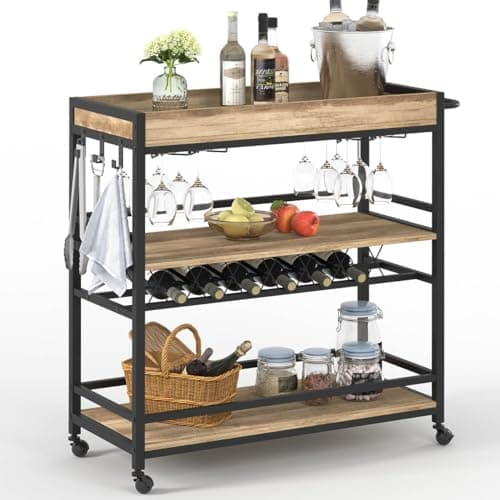
The only wood cart I found that publishes a per-shelf figure anywhere near this: 150 lb on each of three shelves. At 37 inches it is the second-longest cart in our library, wide enough that it stops being a side table and becomes a counter. The catch is that the wood is a grain finish over MDF, not timber.
- Dimensions
- 14.17"D x 37.01"W x 35.24"H
- Weight
- 39.79 lb
- Load per shelf
- 150 lb, on all three
- Materials
- MDF shelves, metal tube frame
- Storage
- Wine rack for 6, stemware racks for 12
- Shelf gap, middle to bottom
- 16.3"
- Clearance under the wine rack
- 11.8"
Specs compiled from: BON AUGURE BNG-BC1841-V published listing, retrieved 2026-09-09.
What is good
- 150 lb a shelf is the highest published figure in our library, by 40 lb
- 14.17 inches deep takes a standard 12 by 16 inch tray flat
- A wine rack and two stemware racks stop glasses eating shelf area
What is not
- Vintage oak here is a wood-grain finish on MDF, not solid wood
- 37 inches wide needs a wall, not the gap beside a sofa
- The listing gives the height as both 35.24 and 35.23 inches and the width as both 37.01 and 37.12
#ad Disclosure · Price as of October 18, 2026
A first cart
HOOBRO 2-Tier Bar Cart (BF56TC01)
HOOBRO
Two shelves, 16.7 lb, 44 lb rated on each. The lowest-commitment cart in this registry and the one I would put in a rented flat: light enough to move weekly, cheap enough that a scratch is not a crisis.
- Dimensions
- 24.4"L x 13.8"W x 33.1"H
- Weight
- 16.7 lb
- Load per shelf
- 44 lb top, 44 lb bottom
- Materials
- Particleboard and metal frame
- Shelves
- 2
Specs compiled from: HOOBRO BF56TC01 published listing, retrieved 2026-09-02.
What is good
- 16.7 lb moves with one hand, which is the entire point of a cart
- 33.1 inches tall sits close to the middle of the published range
- Two shelves means less to style badly
What is not
- 44 lb a shelf is the lowest rating here, roughly nine full 750 ml bottles
- Particleboard edges are the first thing to fail on a cart that gets knocked
- No wine rack or stem holder, so glasses eat shelf area
How these were picked
I have not tested any of these carts. What I did instead: compiled the published specifications from each listing, recorded the figures with their source, checked the footprint against the clearances a real room has, worked out how many standard bottles a stated shelf actually holds, and named the one I would skip. Where two listings for the same cart disagree, the page says so rather than quietly picking one.
Frequently asked
Questions
Are bar carts still in style in 2026?
What is replacing bar carts?
How do I make a bar cart look current?
Is it worth buying a bar cart now?
Sources
Where the facts on this page came from
- Standard 750 ml bottle dimensions — Dimensions.com
- Bar cart history and format overview — Loomlan bar cart guide
Specifications attributed to a retailer listing were read from that listing on the date shown on each product card. Listings change; if you find one that no longer matches what we published, tell us and we will check it and correct the page.
Read next
Related pages
Filed under Basics. Permanent link: /basics/are-bar-carts-out-of-style