Section 01 · Basics
Are bar carts tacky?
No — but four specific, common choices make one look it, and three of them are decided before you buy. Here is which, and what to buy instead.
We earn a commission if you buy through our links, at no extra cost to you. We have not tested these carts. Here is what we did instead.
The shortlist
Quick picks
Tap a row for the full write-up. The price button opens Amazon.
| # | Product | Best for | Price |
|---|---|---|---|
| 01 | 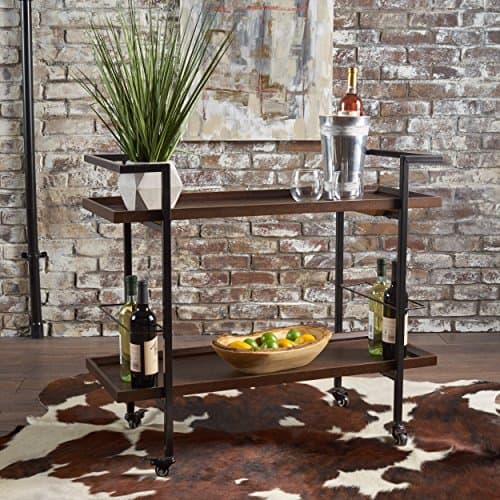 Christopher Knight Home Gerard Bar Cart (301872) The best-looking cart on this page and the one with the least published about it. | Walnut over iron | |
| 02 | 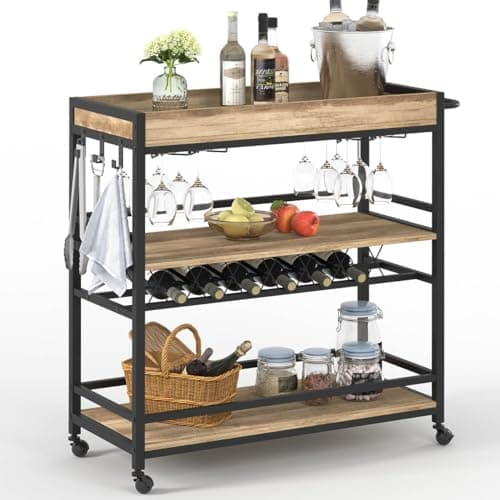 BON AUGURE 3-Tier Bar Cart, Vintage Oak (BNG-BC1841-V) The only wood cart I found that publishes a per-shelf figure anywhere near this: 150 lb on each of three shelves. | Weight, and lots of it | |
| 03 | 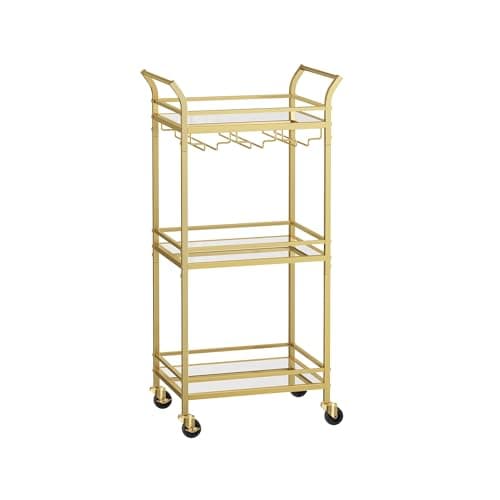 VASAGLE 3-Tier Gold Bar Cart (ULRC091A62) The narrowest three-tier gold cart with published numbers I could find at this price. | Narrow gaps | |
| 04 | 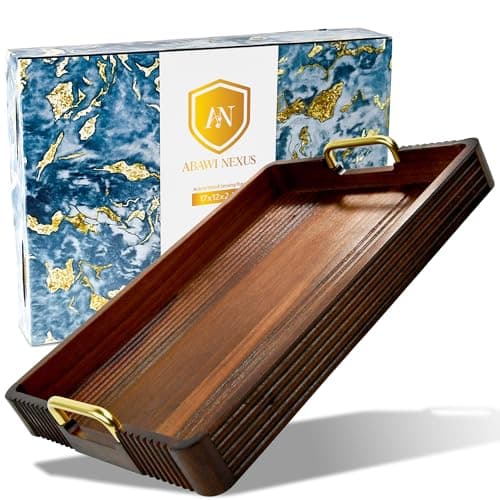 Abawi Nexus Acacia Serving Tray, 17 x 13 in Acacia with metal handles, 17 by 13 inches, and — rarest of all in this category — a published weight limit of 11 lb. | The one that carries |
#ad · We earn a commission on qualifying Amazon purchases, at no extra cost to you. Prices come from Amazon and change.
No. But the question is asked often enough, and specifically enough, that it deserves a real answer rather than reassurance — people typing it have usually seen a bar cart that was tacky and are trying to work out whether the object or the execution was the problem.
It was the execution, and it is almost always one of four things. Three of the four are decided at the point of purchase, which is why this page ends in picks rather than in styling advice. The one I would start with is the Christopher Knight Home Gerard: dark walnut over black iron, two lipped shelves, no ornament anywhere on the frame. It is the shape that is hardest to get wrong.
The four things that actually read as tacky
One: applied ornament on the frame. Scalloped shelf edges, scrollwork, fluted uprights, decorative finials. This is the single biggest predictor, and it is entirely visible in the listing photograph. Ornament dates at the speed of the trend that produced it; plain geometry does not. A rectangular frame in one finish with a simple handle will look as reasonable in ten years as it does now.
Two: a mirrored shelf you do not maintain. Mirrored glass is not tacky. Mirrored glass with fingerprints, a water ring and a film of dust is, and that is the default state of a mirrored shelf in a real house. The finish is a commitment to wiping, and the honest comparison is on glass versus mirrored shelves.
Three: too many objects. A cart has about three square feet of surface. The arrangement that reads as cluttered rather than composed is almost always simply too full — and a crowded cart is what most people picture when they say tacky. The fix is subtraction, and the method is on how to style a bar cart.
Four: nothing on it has been opened. The tell that dates a bar cart faster than any finish: three sealed bottles, a shaker still shiny in its box, a decorative pineapple. That is a still life, and still lifes read as staging. A cart with a half-empty bottle of something decent and two glasses that get used does not look tacky in any finish.
Notice that the first two are purchase decisions and the second two are habits. That split is the whole answer to the question.
What I looked for, given that
A plain frame. No applied ornament, no scalloping, no fluting. Checkable from the photograph, which makes it the most useful filter on this page.
A forgiving shelf. Wood, wood-look or clear glass rather than mirrored — surfaces that look acceptable on a normal Tuesday rather than only after wiping.
Depth enough for a tray. About 15 inches. A tray is the cheapest thing that makes a cart look intentional, because it draws a border and turns six objects into one group. Sizes and published load limits are on bar cart trays.
A published load rating, still. It has nothing to do with taste, but a cart whose shelf sags after two years looks bad in a way no styling fixes. Sag is a slow aesthetic problem as much as a structural one.
The picks, and what each avoids
The safest shape (Christopher Knight Home Gerard). 38 inches wide, 16.1 deep, 33 tall, 21.9 lb. Dark walnut over a black iron frame with two lipped shelves and nothing applied to it anywhere. The lip is the only detail on the whole object, and it is functional. It publishes no load rating at all, which is the honest cost of picking it — and the reason it is the safest-looking rather than the best-specified.
The one that will still look right (BON AUGURE vintage oak). 37.01 by 14.17 inches, 150 lb per shelf on all three, with a wine rack and two stemware racks. Plain steel tube, oak-grain shelves, no ornament. The racks matter for this question specifically: stemware hanging in a rack reads as a working bar, where the same glasses crowded onto a shelf read as clutter. The wood is a grain finish over MDF, not timber.
Gold done properly (VASAGLE ULRC091A62). Gold is the finish people mean when they say tacky, and it is not the problem — the problem is gold plus ornament plus mirror plus clutter. This is gold on a plain three-tier frame at 18.4 inches wide with 66 lb per shelf, which is a high rating for a 16.9 lb cart. It does have mirrored shelves, so it comes with the wiping commitment; 11.8 inches of depth means no full-size tray.
The cheapest fix (Abawi Nexus acacia tray). Not a cart. 17 by 13 inches of acacia with metal handles and a published 11 lb limit — about four full bottles. If you already own a cart and it looks wrong, this is the first thing to try, because grouping is most of what separates composed from cluttered. Thirteen inches on the short edge needs about 14 inches of shelf, so check the cart first.
The room decides more than the cart does
The same cart reads differently in different rooms, and this is the part most of the advice on this question misses entirely.
A gold cart in a room where gold already appears — door handles, a lamp base, a picture frame — reads as coordinated. The identical cart in a room of brushed nickel and matte black reads as an intrusion, and people call that tacky when what they are seeing is a mismatch. Match metal to metal and the finish question largely dissolves; the method is on how to choose a bar cart finish.
Scale matters the same way. A 34 inch cart beside a low mid-century sofa looms; the same cart against a full-height wall does not. And a cart stranded in the middle of a wall with nothing either side of it looks unanchored in a way that no styling fixes — carts want to sit beside something, which is most of the argument on where to put a bar cart.
What actually reads as expensive
Almost none of it correlates with price, which is the useful finding. Three things do most of the work.
Repetition. Four matching glasses look considered; four mismatched ones look accumulated. This is the cheapest upgrade available and it is why sets of four keep appearing in our glassware picks.
Negative space. An arrangement that leaves part of the shelf empty reads as chosen. A full shelf reads as storage. The object is the same; the restraint is the whole difference.
Height variation. Something tall, something mid, something low. A flat plane of identically sized objects looks like a shop display even when every individual item is good.
Where the reputation came from
One specific arrangement, heavily photographed around the middle of the last decade: a gold frame, mirrored shelves, a brass shaker nobody used, a stack of coffee-table books and an ornamental pineapple. It was a styling convention rather than a piece of furniture, it was reproduced thousands of times, and it aged exactly as fast as any heavily reproduced convention does.
What survived it is the trolley — a wheeled side table with two or three open shelves, which has existed since the 1920s and solves a problem that has not changed. The fuller version of that argument, including what replaced the 2015 styling, is on are bar carts out of style.
The one place taste genuinely divides
Everything above is fixable. One thing is not, and it is worth naming because it is the actual disagreement underneath the question: whether a bar cart should look like a piece of equipment or a piece of decoration.
The equipment reading wants a plain frame, published numbers, visible working stock and nothing on the cart that is not used. The decoration reading wants the cart to finish a corner, and treats the bottles as objects. Neither is wrong, and most complaints about tackiness are really somebody applying one standard to a cart built for the other.
This site is unambiguously on the equipment side, which is why every pick above leads with a dimension rather than a mood. If your instinct is the other one, the honest advice is to buy the plainest frame you can find and put the personality in the glassware and the tray — those are cheap to change when taste moves, and a frame is not.
The two-minute fix if you already own one
Take everything off. Put back one tray, the two bottles you actually pour, the glasses you actually use, and one tall object — a decanter or a good bottle shape — for height. Stop there. Put the plant on the lower shelf rather than the top.
That is the whole intervention, and it works because the problem was almost never the cart. If it still looks wrong afterwards, the issue is one of the two purchase decisions above — ornament or mirror — and no amount of editing fixes those. What goes on it, in order of usefulness, is on what to put on a bar cart and bar cart decor.
Before you order
Zoom in on the frame in the listing photograph and look for anything applied — a scallop, a scroll, a finial, a fluted upright. If it is there, keep looking. Then decide honestly about mirrored glass: it is the best-looking shelf in the category and the one most likely to look bad in your house specifically.
Then check depth against about 15 inches so a tray fits, and check the load rating exists. The finish is the last decision, not the first, and the method for matching it to a room you already have is on how to choose a bar cart finish.
Every pick, in order
The full write-ups
Pick 01 · Walnut over iron
Christopher Knight Home Gerard Bar Cart (301872)
Christopher Knight Home
The best-looking cart on this page and the one with the least published about it. Dark walnut over a black iron frame, 38 inches wide, 21.9 lb, and no load rating anywhere on the listing. Two lipped shelves rather than three, which reads as a design decision rather than a saving.
- Dimensions
- 16.1"D x 38"W x 33"H
- Weight
- 21.9 lb
- Load per shelf
- Not published
- Materials
- Iron frame; shelves listed only as "wood"
- Storage
- Two lipped shelves, two bottle holders
Specs compiled from: Christopher Knight Home Gerard 301872 published listing, retrieved 2026-09-03.
What is good
- 16.1 inches deep is generous, and the lipped shelves stop things sliding off
- 21.9 lb for a 38 inch cart is light enough to reposition alone
- Locking casters, which a lot of design-led carts leave off
What is not
- No published load rating at all, which is the one spec this site most wants
- The material is given only as "wood", so timber or veneered board is a coin toss
- Two shelves, so bottle capacity is limited by area rather than by rating
- A second set of figures on the same listing, 38.25 by 16.5 by 32.25 inches, does not match the headline dimensions
#ad Disclosure · Price as of October 17, 2026
Pick 02 · Weight, and lots of it
BON AUGURE 3-Tier Bar Cart, Vintage Oak (BNG-BC1841-V)
BON AUGURE
The only wood cart I found that publishes a per-shelf figure anywhere near this: 150 lb on each of three shelves. At 37 inches it is the second-longest cart in our library, wide enough that it stops being a side table and becomes a counter. The catch is that the wood is a grain finish over MDF, not timber.
- Dimensions
- 14.17"D x 37.01"W x 35.24"H
- Weight
- 39.79 lb
- Load per shelf
- 150 lb, on all three
- Materials
- MDF shelves, metal tube frame
- Storage
- Wine rack for 6, stemware racks for 12
- Shelf gap, middle to bottom
- 16.3"
- Clearance under the wine rack
- 11.8"
Specs compiled from: BON AUGURE BNG-BC1841-V published listing, retrieved 2026-09-09.
What is good
- 150 lb a shelf is the highest published figure in our library, by 40 lb
- 14.17 inches deep takes a standard 12 by 16 inch tray flat
- A wine rack and two stemware racks stop glasses eating shelf area
What is not
- Vintage oak here is a wood-grain finish on MDF, not solid wood
- 37 inches wide needs a wall, not the gap beside a sofa
- The listing gives the height as both 35.24 and 35.23 inches and the width as both 37.01 and 37.12
#ad Disclosure · Price as of October 17, 2026
Pick 03 · Narrow gaps
VASAGLE 3-Tier Gold Bar Cart (ULRC091A62)
VASAGLE
The narrowest three-tier gold cart with published numbers I could find at this price. At 18.4 inches wide it slots into gaps that defeat almost everything else, and 66 lb per shelf is a high rating for a cart weighing under 17 lb. The trade is depth: 11.8 inches will not take a wide tray flat.
- Dimensions
- 11.8"D x 18.4"W x 36.2"H
- Weight
- 16.9 lb (7.7 kg)
- Load per shelf
- 66 lb (30 kg) static
- Materials
- Steel frame, mirrored tempered glass
- Shelves
- 3, plus wine and stem-glass holders
Specs compiled from: VASAGLE ULRC091A62 published listing, retrieved 2026-09-02.
What is good
- 18.4 inches wide, narrower than most two-tier carts
- 66 lb per shelf is a genuinely high published rating for a 16.9 lb cart
- Wine rack and stem holders are built in, so the shelves stay clear
What is not
- 11.8 inches deep will not hold a standard 12 x 16 inch tray flat
- Mirrored glass shows every fingerprint and water ring
- 36.2 inches tall is above the common 32 to 34 inch band, so it reads tall in a small room
#ad Disclosure · Price as of October 17, 2026
Pick 04 · The one that carries
Abawi Nexus Acacia Serving Tray, 17 x 13 in
Abawi Nexus
Acacia with metal handles, 17 by 13 inches, and — rarest of all in this category — a published weight limit of 11 lb. Eleven pounds is roughly four full bottles, which is the only tray here that can honestly be described as one you carry rather than one you arrange.
- Dimensions
- 17"L x 13"W x 2"H
- Weight
- 1.11 kg (about 2.4 lb)
- Maximum load
- 11 lb
- Materials
- Acacia wood, metal handles
- Finish
- Dark acacia with gold handles
Specs compiled from: Abawi Nexus acacia serving tray published listing, retrieved 2026-09-06.
What is good
- 11 lb published limit, about four full 750 ml bottles
- Acacia takes a knock and a spill better than any board tray here
- 2 inch sides, high enough to stop a glass sliding off in transit
What is not
- 17 by 13 inches will not sit flat on a cart shallower than about 14 inches
- Wood needs occasional oiling if it lives somewhere sunny
- The gold handles are a style commitment, not a neutral choice
#ad Disclosure · Price as of October 17, 2026
How these were picked
I have not tested any of these carts. What I did instead: compiled the published specifications from each listing, recorded the figures with their source, checked the footprint against the clearances a real room has, worked out how many standard bottles a stated shelf actually holds, and named the one I would skip. Where two listings for the same cart disagree, the page says so rather than quietly picking one.
Frequently asked
Questions
Are bar carts tacky?
Are gold bar carts tacky?
What makes a bar cart look expensive?
Should I avoid mirrored shelves?
Sources
Where the facts on this page came from
Specifications attributed to a retailer listing were read from that listing on the date shown on each product card. Listings change; if you find one that no longer matches what we published, tell us and we will check it and correct the page.
Read next
Related pages
Filed under Basics. Permanent link: /basics/are-bar-carts-tacky