Section 05 · Stocking
How to set up a coffee bar cart
The weight is never the problem. The height, the watts and the water are, and all three are published before you buy.
We earn a commission if you buy through our links, at no extra cost to you. We have not tested these carts. Here is what we did instead.
The shortlist
Quick picks
Tap a row for the full write-up. The price button opens Amazon.
| # | Product | Best for | Price |
|---|---|---|---|
| 01 | 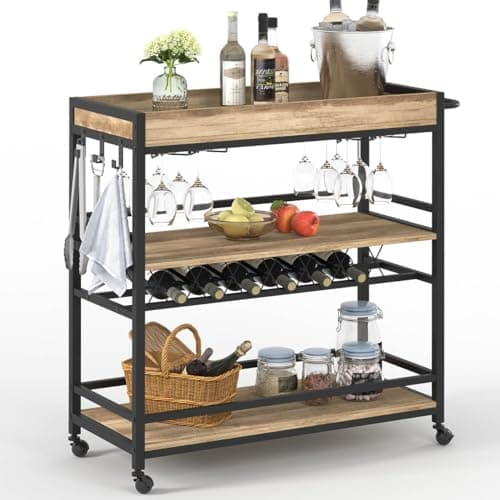 BON AUGURE 3-Tier Bar Cart, Vintage Oak (BNG-BC1841-V) The only wood cart I found that publishes a per-shelf figure anywhere near this: 150 lb on each of three shelves. | Weight, and lots of it | |
| 02 | 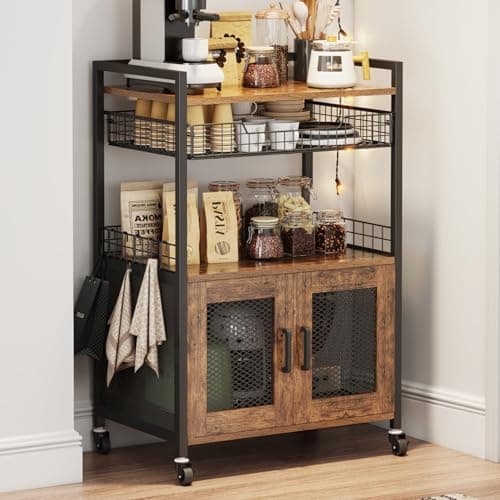 Hencawima 3-Tier Coffee Bar Cabinet on Wheels (CFG-FX) The closest thing in this category to a bar cart that genuinely closes: three tiers on castors with a two-door cabinet underneath, a wire basket drawer and five hooks. | Doors and a drawer | |
| 03 | 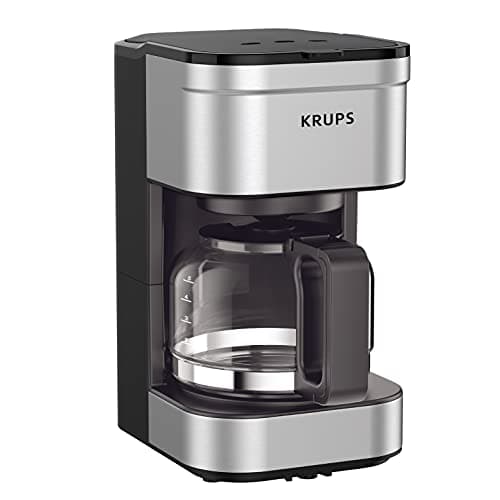 KRUPS Simply Brew Compact 5-Cup Coffee Maker 10.08 inches tall, 5.71 deep and 2.8 lb, which makes it the one drip machine I found that a bar cart can genuinely absorb. | A carafe that fits | $34.99 · View on Amazon
|
| 04 | 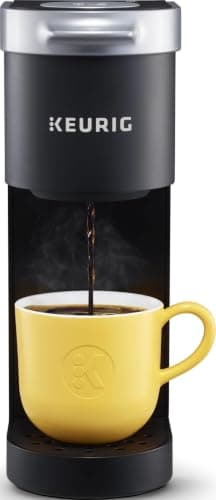 Keurig K-Mini Single Serve Coffee Maker Four and a half inches wide, which is narrower than a standard 750 ml bottle is tall and the reason this machine keeps appearing on carts. | The narrowest machine | $77.49 · View on Amazon
|
| 05 | 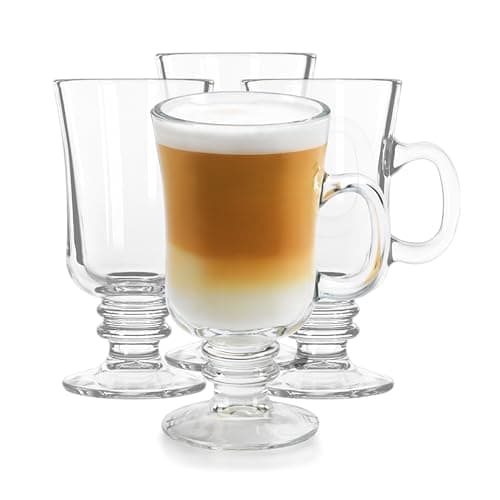 Libbey Irish Coffee Glasses, 8.5 oz (set of 4, 5295) The one piece of glassware a holiday cart needs that a normal cart does not: a footed glass with a handle, so a hot drink can be picked up. | Hot drinks, safely | $23.70 · View on Amazon
|
| 06 | 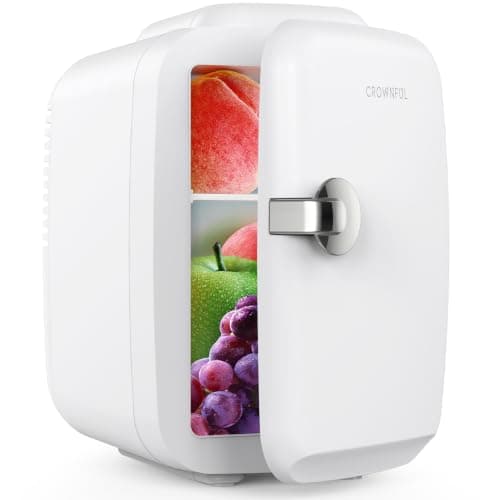 CROWNFUL 4-Liter Mini Fridge (CF-PC4LBLK) 4.4 lb and under 8 inches tall, which is the only fridge here that fits in the shelf gap of a normal three-tier cart. | Fitting an actual gap |
#ad · We earn a commission on qualifying Amazon purchases, at no extra cost to you. Prices come from Amazon and change.
A coffee cart is the most popular thing to do with a bar cart that is not a bar, and it fails more often than it should — not because the idea is bad but because people check the wrong number. The instinct is to worry about weight. Weight is almost never the problem.
A compact drip machine weighs 2.8 lb. A single-serve pod machine weighs 4.6 lb. Against shelf ratings that run from 33 lb to 150 lb across our model library, those are rounding errors. What actually decides whether a coffee cart works is height, watts and water — and all three are published before you buy.
The cart to start from is the BON AUGURE vintage oak, for one reason that matters more here than anywhere else on this site: it publishes the gap between its shelves. 16.3 inches, which is the only figure in our library large enough to put a machine under a shelf rather than on top of one.
Number one: height against the shelf gap
This is the one that kills most coffee cart plans, and it is arithmetic rather than judgment.
A three-tier cart around 33 inches tall has roughly 8 to 9 inches between shelves, by the working on how much space is between bar cart shelves. Now measure the machines. The compact drip machine here is 10.08 inches tall. The pod machine is 12.1. Neither fits.
So on a normal three-tier cart the machine goes on the top shelf, where the only thing above it is the ceiling — and that is the shelf you were going to use as a work surface. That single fact reshapes the whole layout: mugs and beans move down, and the top becomes the machine's.
There are two ways out. Buy a two-tier cart, which has one large gap instead of two small ones. Or buy the one three-tier cart that publishes a genuinely large gap — 16.3 inches clears both machines on this page with room above them, which turns the middle shelf into a machine bay and gives the top back.
Number two: watts, and what else is on the circuit
Rarely discussed and occasionally the thing that trips a breaker. The pod machine here draws 1,500 watts. The drip machine draws 650. That is a factor of more than two for a machine that makes less coffee at once.
Pod machines pull hard because they heat a small volume of water very fast on demand; drip machines heat more water more slowly. On its own either is fine on a normal domestic circuit. It matters when the cart is on an extension lead shared with something else, or in a room where the circuit is already carrying a heater or a microwave.
The practical rule: a coffee cart wants its own socket, not a shared extension. Which leads directly to the least convenient fact about this whole idea.
Number three: the cord means the cart stops rolling
A bar cart's entire justification is that it comes to where people are. A coffee machine has to be plugged in. Put them together and you have a cart that lives within a cord's length of a socket and never moves — a console table with wheels you paid for and will not use.
That is not a reason to abandon the plan, but it is a reason to be honest about what you are building. A coffee cart is a compact, movable-in-principle sideboard. If you genuinely need the drinks to travel, the answer is to brew in the kitchen and carry the pot out on a tray, which is the same conclusion reached on bar carts and mini fridges for the same reason.
One genuinely useful detail: the pod machine here has cord storage built in. On a cart that gets repositioned even occasionally, a cord that tidies away rather than trailing is worth more than it sounds.
Number four, which nobody plans: where the water comes from
The pod machine on this page has no water reservoir at all. Its own listing says "add water each time". That is completely fine on a kitchen counter next to a tap and it is a genuine daily annoyance on a cart in a living room, because every single cup is a trip.
The drip machine holds enough for five cups at once, so it is one fill per brew rather than one per cup. If the cart is more than a few steps from a tap, that difference is the one that decides which machine you should buy, and it is published on both listings.
The other half of the water problem is what comes out. Used pods, spent grounds and a wet filter all have to go somewhere, and a cart has no bin. This is the strongest argument for an enclosed cart: a cupboard or a drawer is where the waste tin, the spare pods and the filters live so they are not on display.
What I chose these on
Published height, first. Because of the shelf-gap arithmetic above, a machine's height is the single most decisive figure and both machines here publish it.
A published shelf gap or a published rating on the cart. Almost no cart publishes a gap; one does, and it is on this page for that reason.
Somewhere to hide the consumables. Coffee generates clutter that a bar does not — pods, filters, a grinder, sugar, a waste tin. An open cart has nowhere for any of it.
Heat-safe glassware with a handle. A tumbler of hot coffee is not liftable. This is the one piece of the kit that is genuinely coffee-specific and it is cheap.
What I did not weigh: shelf load ratings. As set out above, at 2.8 and 4.6 lb the machines are irrelevant against any published rating. The rating only becomes the constraint with a bean-to-cup machine, which is a different class of object and does not belong on a cart — the weight arithmetic for those is on the bar cart without alcohol.
The six, and what each solves
The cart (BON AUGURE vintage oak). 37.01 by 14.17 inches, 150 lb per shelf, and — the reason it is first — a published 16.3 inches between the middle and bottom shelves. That clears both machines on this page, which means the machine can live on the middle shelf and the top stays a work surface. It is MDF with an oak grain rather than timber, and at 39.79 lb it is not going anywhere once positioned.
The cart that hides things (Hencawima CFG-FX). 23.7 inches wide, 15 deep, 35.9 tall, with a two-door cabinet, a wire basket drawer and five hooks. It is sold as a coffee station, which is what nearly every enclosed cart is sold as, and it is the answer to the consumables problem: pods and filters in the drawer, the waste tin behind the doors. It publishes no load rating and no item weight.
The machine that fits (KRUPS Simply Brew). 10.08 inches tall, 5.71 deep, 2.8 lb, 650 watts, five cups, reusable filter. The shortest, lightest and least power-hungry real machine here, and the reusable filter means one fewer consumable to store. The glass carafe is the one breakable thing in this setup, on an object with wheels.
The machine that is narrow (Keurig K-Mini). 4.5 inches wide, which is why it turns up on so many carts — it leaves most of the shelf still usable. 12.1 inches tall, 4.6 lb, 1,500 watts, and no water reservoir. Buy it if the cart is near a tap and shelf width is your constraint; do not buy it if it is across the room from one.
The glass (Libbey Irish coffee, set of four). 8.5 fl oz, footed, with a handle. The handle is the whole point: a hot drink on a cart has to be liftable, and a rocks glass is not. Four is the right number for a cart rather than the twelve a case gives you. It publishes no height, so plan on the top shelf.
The milk (CROWNFUL 4-liter cooler). 7.96 inches tall, which is the one powered box on this site small enough to sit in the roughly 8 inch gap a normal three-tier cart actually has. It cools and it warms, both of which a coffee cart can use. It is thermoelectric, so in a warm room it is a way to keep milk cool rather than refrigeration, and six cans is its whole capacity.
The layout that actually works
Given all of the above, there is one arrangement that falls out of the numbers rather than out of taste.
Machine on the top shelf on a normal three-tier cart, because it will not fit anywhere else — or on the middle shelf if your cart publishes a gap over about 13 inches. That is the single decision everything else follows from.
Mugs and glasses on the shelf below the machine, so pouring is one movement rather than a reach across. Handled glass, not tumblers.
Consumables behind a door or in a drawer if the cart has one. If it does not, put them in a closed tin rather than on display — coffee clutter is the thing that makes these setups look untidy, and it is all small and branded.
A tray on the working shelf, which matters more on a coffee cart than a bar cart for a specific reason: drip machines drip, and boards fail at the front lip where the drips land. Sizes and published load limits are on bar cart trays. The wider styling method is the same as for any cart — how to style a bar cart applies without modification.
What a coffee cart costs
Prices move, so the buttons on this page fetch the current figure rather than quoting one at you. The shape is worth knowing because it is not what people expect: the machine is rarely the expensive part.
A compact drip machine and a pod machine sit in the same modest bracket, and both are cheaper than any cart on this page. The cart is the largest line by some distance, and an enclosed cart with doors costs more again than an open one of the same width because you are paying for the carcass. Glassware in fours is the smallest line.
Which means the sensible order to spend in is cart first, machine second — the opposite of how most people shop this. Band-by-band cart figures are on how much bar carts cost.
Before you buy anything
Measure the gap between your cart's shelves, or estimate it from the height and tier count. Then check the machine's published height against it and accept the answer rather than hoping — 10 and 12 inches do not fit into 8.
Then find the socket. Then decide how far the cart is from a tap, because that single distance is what separates the two machines here. And then be honest about whether this cart is ever going to move: if the answer is no, you may be shopping for an enclosed cart or a sideboard rather than a trolley, and bar cart versus sideboard makes that case properly.
Every pick, in order
The full write-ups
Pick 01 · Weight, and lots of it
BON AUGURE 3-Tier Bar Cart, Vintage Oak (BNG-BC1841-V)
BON AUGURE
The only wood cart I found that publishes a per-shelf figure anywhere near this: 150 lb on each of three shelves. At 37 inches it is the second-longest cart in our library, wide enough that it stops being a side table and becomes a counter. The catch is that the wood is a grain finish over MDF, not timber.
- Dimensions
- 14.17"D x 37.01"W x 35.24"H
- Weight
- 39.79 lb
- Load per shelf
- 150 lb, on all three
- Materials
- MDF shelves, metal tube frame
- Storage
- Wine rack for 6, stemware racks for 12
- Shelf gap, middle to bottom
- 16.3"
- Clearance under the wine rack
- 11.8"
Specs compiled from: BON AUGURE BNG-BC1841-V published listing, retrieved 2026-09-09.
What is good
- 150 lb a shelf is the highest published figure in our library, by 40 lb
- 14.17 inches deep takes a standard 12 by 16 inch tray flat
- A wine rack and two stemware racks stop glasses eating shelf area
What is not
- Vintage oak here is a wood-grain finish on MDF, not solid wood
- 37 inches wide needs a wall, not the gap beside a sofa
- The listing gives the height as both 35.24 and 35.23 inches and the width as both 37.01 and 37.12
#ad Disclosure · Price as of October 17, 2026
Pick 02 · Doors and a drawer
Hencawima 3-Tier Coffee Bar Cabinet on Wheels (CFG-FX)
Hencawima
The closest thing in this category to a bar cart that genuinely closes: three tiers on castors with a two-door cabinet underneath, a wire basket drawer and five hooks. It is sold as a coffee station, which is what almost every enclosed cart is sold as, and the shape works identically for bottles.
- Dimensions
- 15"D x 23.7"W x 35.9"H
- Load per shelf
- Not published
- Materials
- Carbon steel frame
- Storage
- 2-door cabinet, wire basket drawer, 5 hooks
- Shelves
- 3
Specs compiled from: Hencawima CFG-FX published listing, retrieved 2026-09-13.
What is good
- A real two-door cabinet, so the part of a bar you would rather not display can be shut away
- A wire basket drawer as well, which open carts never have
- 35.9 inches tall keeps the top surface at standing pouring height
What is not
- No published load rating on any shelf, and no published item weight either
- Doors need swing clearance in front, which an open cart does not
- It is marketed as a coffee station, so the listing photography shows mugs rather than bottles
#ad Disclosure · Price as of October 17, 2026
Pick 03 · A carafe that fits
KRUPS Simply Brew Compact 5-Cup Coffee Maker
KRUPS
10.08 inches tall, 5.71 deep and 2.8 lb, which makes it the one drip machine I found that a bar cart can genuinely absorb. It draws 650 watts against the 1,500 a pod machine wants, and it makes five cups at once rather than one at a time — which is what you want if the cart is serving more than one person.
- Dimensions
- 5.71"D x 8.07"W x 10.08"H
- Weight
- 2.8 lb
- Capacity
- 5 cups
- Power
- 650 watts
- Filter
- Reusable, #2
Specs compiled from: KRUPS Simply Brew published listing, retrieved 2026-09-14.
What is good
- 2.8 lb means the shelf rating is never the constraint, published or not
- 650 watts is less than half a pod machine, which matters on a shared circuit
- A reusable filter means no consumable to store on a cart with no storage
What is not
- 10.08 inches tall still clears almost no three-tier cart's shelf gap
- A glass carafe on a wheeled object is the one breakable part of this setup
- Five cups is a carafe to keep warm or throw away, unlike a single-serve pour
Pick 04 · The narrowest machine
Keurig K-Mini Single Serve Coffee Maker
Keurig
Four and a half inches wide, which is narrower than a standard 750 ml bottle is tall and the reason this machine keeps appearing on carts. It is 12.1 inches tall and draws 1,500 watts, and it has no water reservoir at all — you fill it for every cup, which on a cart away from a tap is the thing to think hardest about.
- Dimensions
- 11.3"D x 4.5"W x 12.1"H
- Weight
- 4.6 lb
- Brew size
- 6 to 12 fl oz
- Power
- 1,500 watts
- Water
- No reservoir — filled per cup
Specs compiled from: Keurig K-Mini published listing, retrieved 2026-09-14.
What is good
- 4.5 inches wide leaves most of the shelf still usable, which no other machine does
- 4.6 lb, so the shelf rating is not the constraint
- Cord storage built in, which on a cart that moves is more useful than it sounds
What is not
- No water reservoir: every cup is a trip to the tap, and a cart is not near a tap
- 12.1 inches tall clears no normal three-tier shelf gap — this is a top-shelf object
- 1,500 watts is a real load if the cart shares a circuit with other appliances
Pick 05 · Hot drinks, safely
Libbey Irish Coffee Glasses, 8.5 oz (set of 4, 5295)
Libbey
The one piece of glassware a holiday cart needs that a normal cart does not: a footed glass with a handle, so a hot drink can be picked up. Eight and a half ounces is a mug of cocoa or a mulled wine with room left, and a set of four is the right number for a cart rather than a case for a bar.
- Capacity
- 8.5 fl oz
- Sold as
- Set of 4
- Material
- Lead-free glass
- Care
- Dishwasher safe, per the listing
- Model
- 5295
Specs compiled from: Libbey 5295 published listing, retrieved 2026-09-07.
What is good
- A handle, which is what lets a hot drink live on a cart at all
- 8.5 oz suits cocoa and mulled wine without being a soup bowl
- Libbey is stocked everywhere, so one breakage is not the end of the set
What is not
- No published height or diameter, and height is what a shelf gap cares about
- The listing gives a 300 g item weight without saying whether that is one glass or four
- Clear glass shows a cocoa ring in a way an opaque mug does not
Pick 06 · Fitting an actual gap
CROWNFUL 4-Liter Mini Fridge (CF-PC4LBLK)
CROWNFUL
4.4 lb and under 8 inches tall, which is the only fridge here that fits in the shelf gap of a normal three-tier cart. It is a thermoelectric cooler holding six cans, so treat it as a way to keep two mixers cold rather than as refrigeration.
- Dimensions
- 5.33"D x 6.05"W x 7.96"H
- Weight
- 4.4 lb
- Capacity
- 4 L, listed as 6 cans
- Cooling
- Thermoelectric, cools and warms
- Listing
- ETL listed
Specs compiled from: CROWNFUL CF-PC4LBLK published listing, retrieved 2026-09-06.
What is good
- 7.96 inches tall fits the roughly 8 inch gap a three-tier cart actually has
- 4.4 lb is nothing on any shelf, rated or not
- It warms as well as cools, which is genuinely useful on a coffee cart
What is not
- Thermoelectric cooling works off ambient temperature, so a warm room limits it
- Six cans is two drinks each for three people and then it is empty
- 5.33 by 6.05 inches means no bottle taller than a can goes in it
#ad Disclosure · Price as of October 17, 2026
How these were picked
I have not tested any of these carts. What I did instead: compiled the published specifications from each listing, recorded the figures with their source, checked the footprint against the clearances a real room has, worked out how many standard bottles a stated shelf actually holds, and named the one I would skip. Where two listings for the same cart disagree, the page says so rather than quietly picking one.
Frequently asked
Questions
Will a coffee maker fit on a bar cart?
Is a coffee machine too heavy for a bar cart?
Pod machine or drip machine for a cart?
Can I put an espresso machine on a bar cart?
What glasses do you need for a coffee cart?
Sources
Where the facts on this page came from
Specifications attributed to a retailer listing were read from that listing on the date shown on each product card. Listings change; if you find one that no longer matches what we published, tell us and we will check it and correct the page.
Read next
Related pages
Filed under Stocking. Permanent link: /stocking/coffee-bar-cart-setup