Section 05 · Stocking
Nick and Nora or coupe?
Two stemmed glasses for the same drinks, separated by one measurable thing: how far the rim leans out over the stem. That decides how much you can carry without wearing it.
We earn a commission if you buy through our links, at no extra cost to you. We have not tested these carts. Here is what we did instead.

Both glasses hold a stirred or shaken drink served without ice. Both sit on a stem so your hand does not warm the liquid. They get used for the same cocktails and they are often sold side by side, which is why the choice feels arbitrary.
It is not arbitrary. The difference is the angle of the bowl. A coupe is wide and shallow, so the surface of the drink sits near the rim and the rim sits well outside the base. A Nick and Nora is a smaller, deeper, more upright bowl — closer to a tiny wine glass — so the liquid sits lower and further inside the footprint.
On a wheeled piece of furniture, that difference stops being aesthetic. A cart gets pushed, and a coupe carried across a room is the most spillable glass in common use. If your cart moves, buy the Nick and Nora — the Bormioli Rocco Novecento is the one to get.
The measurable difference
The published numbers tell most of the story, and the capacities are closer than the shapes suggest:
| Glass | Shape | Capacity | Height |
|---|---|---|---|
| Bormioli Rocco Novecento | Nick and Nora | 5.25 oz | 6 in |
| GLASSIQUE CADEAU Art Deco | Nick and Nora | 5 oz to the rim | 5.9 in |
| MORA Pure | Nick and Nora | 6 oz | 6.3 in |
| Libbey Greenwich | Coupe | See glassware page | See glassware page |
Note what the capacity column does not say. A coupe and a Nick and Nora of the same stated volume behave differently because the coupe reaches that volume across a wide shallow surface. Fill either to 80 percent and the coupe's liquid sits a quarter-inch from a rim that is several inches across; the Nick and Nora's sits lower in a bowl that curves back inward.
Why the coupe spills and the Nick and Nora does not
Liquid in a moving glass sloshes, and how far it travels up the wall depends on how far the wall leans away from vertical.
A coupe's wall is closer to horizontal than vertical near the rim. A small tilt moves the surface a long way across that wall, and because the rim is wide, the liquid has a short distance to travel before it arrives at the edge. This is why a coupe spills on the way from the cart to the sofa and a wine glass does not.
A Nick and Nora's wall curves back in. The same tilt pushes liquid against a wall that is heading inward, which returns it to the bowl. The glass was designed in the 1930s for exactly this — it is the glass from the Thin Man films, made for drinks carried around a room at a party.
The stem is the other half. Both glasses are picked up by the stem in theory and by the bowl in practice. A narrower bowl is easier to hold correctly, which keeps a hand off the glass and the drink colder for longer — the reason this whole shape exists.
Where each one wins
The coupe wins on looks and on service. Nothing photographs like a coupe, it stacks visually on an open shelf, and for a drink poured and handed straight over — at a table, at a party, into a waiting hand — the spill risk never materializes. It is also the glass for anything with a foam or a float, because the wide surface is the point.
The Nick and Nora wins on everything involving movement. Carrying a drink, handing one across a room, setting one down on a cart that someone might push. It is also the better glass for a smaller pour: a 5 oz cocktail looks correct in it and looks mean in a wide coupe.
On a cart specifically, the Nick and Nora also stores better. The narrower bowl takes less shelf area upside down, and it is less likely to chip against a neighbor, because the widest part of the glass is not the part nearest the next glass. How to store either without breakage is on how to store glasses on a bar cart.
The four, and who each is for
The pick (Bormioli Rocco Novecento, 5.25 oz). Six inches tall, made in Italy, with the bowl and stem drawn from a single piece of glass so there is no seam at the join — which is where stemware breaks. It is also the least expensive set here. Against it: 5.25 oz is small if you pour generously, the profile is plain next to the decorative sets, and a laser-cut thin rim means hand washing in practice.
The decorative one (GLASSIQUE CADEAU Art Deco, 5 oz). Hand-blown and ribbed, unmistakably deco, and at 5.9 inches the shortest glass here — which makes it the one most likely to clear a tight shelf gap. The box is designed to double as a storage case, which genuinely matters on a cart with no cupboard. Hand-blown means visible variation between glasses, per the listing; 5 oz to the rim is a small working pour; and it is the most expensive of the three.
The largest (MORA Pure, 6 oz). The most usable capacity of the three and lead-free, hand-blown. If your cocktails are 4 oz rather than 3, this is the one with room for them. At 6.3 inches it is the tallest here, so it is the one to measure against a shelf; the set is 3.65 lb for four glasses, which is heavy for stemware; and the plain profile reads modern rather than period.
The coupe, for comparison (Libbey Greenwich). Included because the honest answer for most carts is one of each: a pair of coupes for drinks poured and handed over, a pair of Nick and Noras for drinks carried. The Libbey is compiled with its published height on the glassware page, where the whole set is chosen by height rather than by prestige.
Where the shape came from
Worth knowing, because the history explains the design rather than decorating it.
The coupe is the older shape and was originally a champagne glass. Its wide bowl was built for a wine that was sweeter and less aggressively carbonated than modern champagne — and when tastes changed, the flute took over for sparkling wine and the coupe was left looking for a job. Cocktails gave it one.
The Nick and Nora is named for the married detectives in the Thin Man films of the 1930s, who drink continuously and at length throughout. The glass they are usually shown with is small, footed and upright — a shape that already existed as a wine tasting glass, and which the modern cocktail revival adopted around two decades ago precisely because the coupe was spilling.
That is the useful part. The Nick and Nora was not designed to look period; it was chosen by working bartenders for a practical reason, which is why it behaves better on a cart than the glass it replaced.
Washing and storing stemware
Both shapes are thin, stemmed and easy to break, and most breakage happens at the sink rather than in use.
Wash one at a time, by the bowl. Twisting a glass by the base while holding the bowl is how stems snap, and it usually happens with a cloth inside the glass. Hold the bowl, turn the cloth, not the glass.
Hand wash the thin-rimmed ones. A laser-cut rim is thinner than a rolled one, which is what makes it pleasant to drink from and vulnerable to knocking against a dishwasher rack. The Bormioli here has one; so does most decent stemware.
Store them where they are not touching. Stemware chips at the rim, and the rim is the part that meets the neighboring glass when a cart is pushed. On a cart that means spacing rather than nesting, and it is why four glasses take about a foot of shelf. If that space is not available, hanging them is the answer — wine glass racks covers what mounts to what.
What to serve in which
Nick and Nora: martinis, Manhattans, negronis served up, daiquiris, anything stirred and strong where the pour is 3 to 4 oz and the drink needs to stay cold in the hand.
Coupe: champagne cocktails, anything with a foam or an egg white, sours served up, and any drink where the surface is part of the presentation — a citrus twist laid across, a dusting of nutmeg, a float.
Neither, for anything with ice. Both of these are served-up glasses — the drink is chilled during mixing, strained, and served without ice. Putting a cube in either one crowds a small bowl and defeats the stem, which exists so your hand does not warm the drink. If the drink takes ice, it wants a rocks glass, and the heights of those are compiled on the glassware page alongside what will actually stand on a cart shelf.
Either: most classics, honestly. The bartending world has moved toward the Nick and Nora for stirred drinks and kept the coupe for anything with texture, but no one will correct you. The one place the choice is not free is a moving cart, which is the whole argument of this page.
Before you order
Measure the shelf gap and compare it to the heights above — 5.9 to 6.3 inches here, which clears most carts but not all, and the glassware page has the coupe figures alongside. Then decide whether drinks get carried away from the cart or handed over at it, because that is the question this comparison actually turns on.
And if you are buying one shape only, buy the Nick and Nora: it does everything the coupe does and survives being carried, which on a wheeled piece of furniture is the whole argument. Buy four rather than twelve. The full set of what earns space on a cart is on what to put on a bar cart.
What I would buy
The picks this page points to
These sit here rather than at the top on purpose: the advice above is what decides the choice, and a recommendation only means something once you know what you are choosing between.

The one made in Italy
Bormioli Rocco Bartender Novecento Nick & Nora Glasses, 5.25 oz, Set of 4 (122113GRS021990)
Bormioli Rocco
5.25 oz, six inches tall, with the bowl and stem drawn from one piece of glass so there is no seam where a stem usually snaps. Laser-cut thin rim, made in Italy, and the least expensive set here.
- Capacity
- 5.25 oz
- Height
- 6"
- Count
- Set of 4
- Construction
- Seamless bowl and stem
- Origin
- Made in Italy
Specs compiled from: Bormioli Rocco 122113GRS021990 published listing, retrieved 2026-09-27.
What is good
- No seam between bowl and stem, which is where stemware usually fails
- 6" tall clears the shelf gap on almost any cart
- A laser-cut rim at the cheapest price in this group
What is not
- 5.25 oz is small if you pour a generous cocktail
- Plain profile next to the decorative sets here
- Thin rim means hand washing in practice
#ad Disclosure · Price as of October 18, 2026
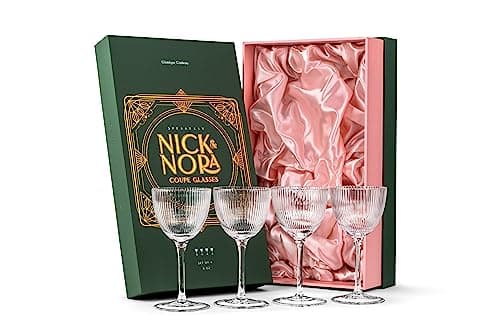
The look on an open shelf
GLASSIQUE CADEAU Art Deco Ribbed Nick and Nora Glasses, 5 oz, Set of 4
GLASSIQUE CADEAU
Hand-blown, ribbed and unmistakably deco, at 5 oz to the rim and 5.9 inches tall — the shortest glass here and the one that looks like it belongs on a brass cart. Sold in a box designed to double as storage.
- Capacity
- 5 oz to the rim
- Height
- 5.9"
- Count
- Set of 4
- Construction
- Hand-blown crystal glass
- Storage
- Gift box doubles as a case
Specs compiled from: GLASSIQUE CADEAU Nick and Nora published listing, retrieved 2026-09-27.
What is good
- 5.9 inches is the shortest here, so it clears the tightest shelf gaps
- The box is a usable storage case, which matters on a cart with no cupboard
- Ribbed deco profile suits gold and brass carts
What is not
- Hand-blown means small bubbles and slight variation between glasses, per the listing
- 5 oz to the rim is a small pour once you allow headroom
- The most expensive set of the three here
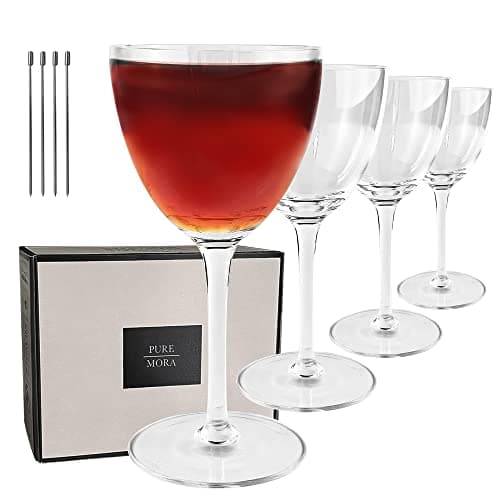
The largest pour
MORA Pure Nick and Nora Glasses, 6 oz, Set of 4
MORA
6 oz, which is the most usable capacity of the three, hand-blown and lead-free. At 6.3 inches it is also the tallest, so it is the one to measure against a shelf before buying.
- Capacity
- 6 oz
- Height
- 6.3"
- Count
- Set of 4
- Material
- Lead-free, hand-blown
- Weight
- 3.65 lb per set
Specs compiled from: MORA Pure Nick and Nora published listing, retrieved 2026-09-27.
What is good
- 6 oz leaves headroom for a full cocktail without filling to the rim
- Lead-free, which the listing contrasts with leaded cocktail glassware
- Hand-blown at a mid-range price
What is not
- 6.3" is the tallest of the three and the most likely to foul a low shelf
- 3.65 lb for four glasses is heavy for stemware
- Plain profile, so it reads modern rather than period
#ad Disclosure · Price as of October 18, 2026
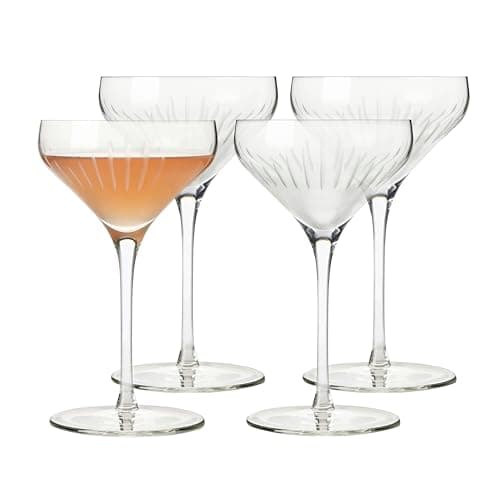
Buying four, not twelve
Libbey Signature Greenwich Coupe, 8 oz (set of 4)
Libbey
The same idea as the Perception in a set of four rather than a case of twelve, which is what a home cart actually needs. Published at 3.9 by 3.9 by 6.5 inches, so plan for a 6.5 inch shelf gap.
- Capacity
- 8 oz
- Dimensions
- 3.9 x 3.9 x 6.5 in
- Sold as
- Set of 4
- Material
- Lead-free glass
- Care
- Dishwasher safe
Specs compiled from: Libbey Signature Greenwich published listing, retrieved 2026-09-02.
What is good
- Four is the right number for a two-shelf cart
- 8 oz is the useful modern coupe size
- Widely stocked, so a breakage is replaceable
What is not
- 6.5 inches tall is taller than the case-packed Perception
- Sets of four cost more per glass than a case
- A wide bowl means the same spill risk as any coupe
#ad Disclosure · Price as of October 18, 2026
How these were picked
I have not tested any of these carts. What I did instead: compiled the published specifications from each listing, recorded the figures with their source, checked the footprint against the clearances a real room has, worked out how many standard bottles a stated shelf actually holds, and named the one I would skip. Where two listings for the same cart disagree, the page says so rather than quietly picking one.
Frequently asked
Questions
What is the difference between a Nick and Nora and a coupe?
Which glass is better for a martini?
Which stemmed glass is best on a bar cart?
How many stemmed glasses should live on a cart?
Sources
Where the facts on this page came from
Specifications attributed to a retailer listing were read from that listing on the date shown on each product card. Listings change; if you find one that no longer matches what we published, tell us and we will check it and correct the page.
Read next
Related pages
Filed under Stocking. Permanent link: /stocking/nick-and-nora-vs-coupe