Library · Cart Reviews
Keter Pacific Cool Bar
Not really a cart — a resin side table with a 7.5 gallon cooler under the lid. If the problem is warm drinks rather than storage, nothing else here solves it.
We earn a commission if you buy through our links, at no extra cost to you. We have not tested these carts. Here is what we did instead.
Every other cart on this site solves a storage problem. This one solves a temperature problem, and it is on the site because outdoors that is usually the problem people actually have.
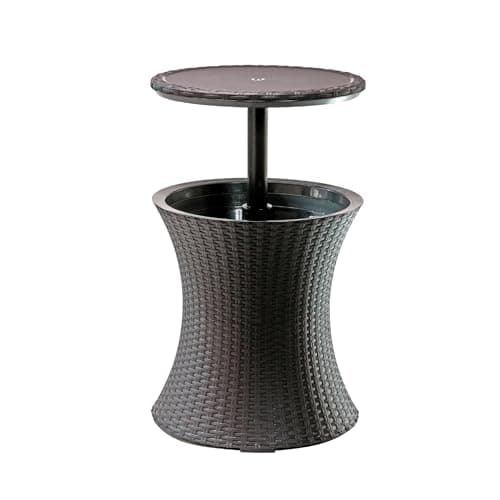
It is a 19.5 inch square resin table, 33.2 inches tall, with a 7.5 gallon insulated cooler under a lift-up lid. Fill the body with ice, put the glasses on top, and the drinks stay cold for the length of an evening without anybody walking to a fridge. That is the whole product, and it does it better than any bucket on a shelf.
The published figures
19.5 inches deep, 19.5 wide, 33.2 tall. 15.4 lb. 110 lb weight capacity on the top surface. 7.5 gallon cooler capacity. Resin throughout, with a rattan-effect finish.
Two of those are quietly impressive. 110 lb published on a 15.4 lb object is a strong ratio, and it means the top genuinely works as a table rather than as a lid you have to be careful with. And 33.2 inches sits squarely in the comfortable serving band, which a lot of cooler furniture misses by being built to seat height.
The figure that defines it is 7.5 gallons. For scale, that is roughly a case of cans plus the ice around them, or half a dozen bottles standing upright in ice with room to spare.
Why a built-in cooler beats a bucket
Three reasons, and they compound outdoors.
Volume. The ice buckets compared on ice buckets and tongs hold 3 to 4 quarts. 7.5 gallons is 30 quarts — roughly eight times as much. A bucket serves a round of drinks; this serves an afternoon.
Insulation geometry. A bucket is a small volume with a large surface area and an open top, which is the worst possible shape for keeping ice. A deep insulated body with a lid is the right shape, and it is why a cooler holds ice for hours where a bucket holds it for one.
The melt-water problem disappears. A bucket on a shelf sweats and drips, and on an engineered-wood shelf that is the exact failure mode that ruins carts. Here the water stays in the body, where it is supposed to be.
Resin, honestly
It is plastic. The finish is called rattan-effect and from three feet away it reads as plastic that is trying, which is the honest description.
What you get for that is total indifference to weather. No oiling, no rust, no swelling, nothing to do at the end of the season except possibly hose it. It is the only thing in our outdoor roundup I would leave out permanently without a second thought, and against a timber cart that wants oiling once or twice a year, that is a real trade rather than a consolation.
The cost of light plastic is wind. At 15.4 lb empty this is the first thing on a patio to move in a gust, particularly on smooth decking. Loaded with ice it is immovable; empty it is not. Keep it filled or keep it sheltered.
What it does not do
It has no open shelves. None. That is the single most important thing to understand before buying it, because every other object in this category is defined by its shelves.
So there is nowhere for bottles to stand, nowhere for glasses to live between uses, nowhere for a tray, and nowhere for the tools. Everything except what is in the ice has to come from indoors and go back indoors. If you want one object that is the whole bar, this is not it.
The 19.5 inch square top is also a side-table footprint rather than a bar one. It takes a tray, a few glasses and an opener; it does not take a working setup. Compare that with the 20-inch-deep, 27-inch-wide timber cart that leads the outdoor roundup, which does.
How it pairs
The configuration that actually works, and the one I would run: this for the cold things, and a conventional cart or table for everything else. The cooler sits where people are, the cart holds the bottles and glasses, and neither is asked to do the other's job.
That is a two-object answer, which is less tidy than one object — but it is the same conclusion the site reaches about putting a fridge on a cart, for the same reason. Trying to make one wheeled item do storage and refrigeration gets you something that does neither well, an argument worked through on bar carts and mini fridges.
Loading it, and how long the ice lasts
Nobody publishes an ice-retention figure for this class of product and I am not going to invent one. What is worth saying is how the variables work, because they are larger than the differences between products.
Ice lasts longest in a full, closed, shaded body. A cooler half full of ice has a large air volume to keep cold and loses it fast; the same cooler packed to the top loses it slowly. Opening the lid repeatedly costs more than an hour of sunshine does. And pre-chilling what goes in matters more than the ice does — room-temperature cans are heated by the ice on the way to cold, which is energy the ice does not get back.
The practical loading order for 7.5 gallons: cans and bottles in first, straight from a fridge if you have the space, then ice poured over and around rather than under. Leave the lid down between rounds. Drain the melt-water before it turns into a lukewarm bath, because water transfers heat far faster than air and a bottle sitting in cold water gets warm quicker than one sitting in ice.
Indoors, none of this applies and the right tool is a 3 quart bucket, which is the subject of ice buckets and tongs.
Who should buy it
Anyone whose outdoor drinks problem is temperature rather than storage. If the pattern in your garden is people standing around with warm cans, this fixes it completely and permanently, needs no power, and can be left out all year.
It also suits a hot tub, a pool edge or a balcony — anywhere the trip back indoors is the actual friction and where a powered fridge is impractical.
The footprint, and where it goes
19.5 inches square is a small footprint for what it holds, and that is the quiet advantage of putting the volume below the surface rather than on shelves beside it. A conventional cart holding comparable drinks would be half as wide again.
Because it is square and has no front, it also has no wrong side — it can sit in the middle of a seating group and be reached from any direction, which almost no bar cart can. That is the placement it is genuinely best at: between chairs rather than against a wall, where a rectangular cart with a back would be facing somebody the wrong way.
It also has no wheels, which the listing does not hide and which suits the weight: at 15.4 lb empty you pick it up rather than roll it. On grass or gravel that is an advantage, since small castors stop dead on both — the wheel question for outdoor carts generally is on bar cart wheels and casters.
Who should not
Anyone who wants a bar cart. This has no shelves, and calling it a cart in the way this site otherwise uses the word would be misleading — it is a cooler with a usable top.
Anyone who wants it to look like furniture close up: resin reads as resin. Anyone on an exposed balcony who will not keep it loaded, at 15.4 lb empty. And anyone whose drinks are mostly spirits rather than cans and bottles, since ice volume is not the constraint on a spirits bar — a 3 quart bucket is.
What I would buy
The picks this page points to
These sit here rather than at the top on purpose: the advice above is what decides the choice, and a recommendation only means something once you know what you are choosing between.
Ice you do not carry
Keter Pacific Cool Bar
Keter
Not really a cart — a resin side table with a 7.5 gallon insulated cooler under a lift-up lid, on a 19.5 inch square footprint. If the problem you are solving is warm drinks on a patio rather than storage, this answers it and nothing else here does.
- Dimensions
- 19.5"D x 19.5"W x 33.2"H
- Weight
- 15.4 lb
- Weight capacity
- 110 lb
- Cooler capacity
- 7.5 gallons
- Materials
- Resin, rattan-effect finish
Specs compiled from: Keter Pacific Cool Bar published listing, retrieved 2026-09-06.
What is good
- A 7.5 gallon insulated cooler built into the body, not a bucket sitting on a shelf
- 15.4 lb and resin throughout, so rain and sun are not a maintenance question
- 110 lb published capacity on the top surface
What is not
- No open shelves at all, so bottles and glasses have nowhere to live
- 19.5 inches square is a side table footprint, not a bar
- Resin with a rattan-effect finish is a plastic that looks like plastic up close
#ad Disclosure · Price as of October 18, 2026
How these were picked
I have not tested any of these carts. What I did instead: compiled the published specifications from each listing, recorded the figures with their source, checked the footprint against the clearances a real room has, worked out how many standard bottles a stated shelf actually holds, and named the one I would skip. Where two listings for the same cart disagree, the page says so rather than quietly picking one.
Frequently asked
Questions
How much does the Keter Pacific Cool Bar hold?
Can it stay outside all year?
Is it actually a bar cart?
Cooler or ice bucket?
Sources
Where the facts on this page came from
Specifications attributed to a retailer listing were read from that listing on the date shown on each product card. Listings change; if you find one that no longer matches what we published, tell us and we will check it and correct the page.
Read next
Related pages
Filed under Cart Reviews. Permanent link: /carts/keter-pacific-cool-bar