Library · Cart Reviews
Christopher Knight Home Sara outdoor bar cart
Timber all the way through rather than timber-effect, with a published capacity and a top tier that lifts off and carries.
We earn a commission if you buy through our links, at no extra cost to you. We have not tested these carts. Here is what we did instead.
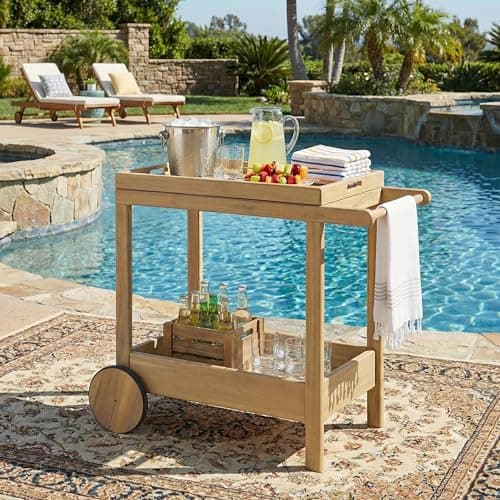
Most carts sold for a patio are indoor carts with a patio photograph. This one is not, and the difference is in the material field rather than the styling: acacia through the frame and the shelves, which is the timber most outdoor furniture is made from.
That is why it leads the outdoor roundup. It also publishes a 120 lb capacity, which very few outdoor carts do, and its top tier lifts off as a tray — the one feature that solves the specific outdoor problem of the drinks being at the cart and the people being at the far end of the garden.
The published figures
35.83 inches wide, 18.7 deep, 30 tall. 28.2 lb. 120 lb weight capacity. Acacia wood, frame and shelves. Two shelves, the top one a removable tray. Four wheels.
Two of those numbers are unusual for the category and both matter. 18.7 inches of depth is generous — it takes a standard 12 by 16 inch tray flat with room to spare, and outdoors depth is what lets a cart hold a cooler box, a platter and glasses at once. And 120 lb published on a 28.2 lb frame is a real figure rather than a marketing round number.
The figure that is not unusual, and is the main compromise: 30 inches tall. That is below the 32 to 36 inch band most carts occupy, which is worked through on how tall a bar cart should be. Thirty inches is dining-table height, not standing-pour height.
Why acacia matters outdoors
Acacia is a dense hardwood with a naturally high oil content, which is why it is the default timber for outdoor furniture at this price. It handles rain, it handles being scrubbed, and a dent in it is still wood underneath rather than swollen board.
The contrast worth drawing is with what most "outdoor" carts actually are. Engineered wood — MDF or particleboard with a grain applied — fails at unsealed cut edges, and on a cart that is the underside of the front lip where the film stops. One heavy dew is enough to start it, and the swelling never goes back down. The material distinctions are on the wood cart page.
What acacia costs you is maintenance, and the listing does not hide it: untreated acacia silvers within a season. Some people want exactly that; others are surprised. Keeping the warm brown means oiling it once or twice a year, and that is the honest running cost of buying timber rather than resin.
The removable tray, which is the real feature
The top tier lifts off and becomes a tray. Indoors that is a convenience; outdoors it is the difference between a cart that gets used and one that gets walked back and forth to. A patio cart is almost always parked near the house and the people are almost always not, and every other cart in the category answers that by making you move the whole cart across uneven ground.
It also solves the storage problem in reverse: at the end of the evening the tray brings everything in at once. Only one other cart on this site does anything comparable, and it is an indoor industrial cart with two lift-out shelves.
Two shelves, and what that costs
Two tiers rather than three, which sounds like a limitation and mostly is not. A two-tier cart at 30 inches has one large gap rather than two small ones, which means a tall bottle stands up on the lower shelf — a standard 750 ml bottle is published at about 11.8 inches, and a three-tier cart in the low thirties has roughly 8 to 9 inches between shelves. The arithmetic is on how much space is between bar cart shelves.
What it does cost is a place to put the things you are not using. On a three-tier cart the middle shelf absorbs the clutter; here it goes on the bottom shelf or it goes indoors. Outdoors that is arguably correct anyway, since anything left on a patio cart overnight gets rained on.
The wheels, and the surface question
The listing publishes four wheels without a diameter, and outdoors diameter is the specification that decides whether a cart moves at all. Small hard casters are designed for smooth floors and stop dead at the joint between two paving slabs or at the edge of a lawn.
At 28.2 lb this is light enough to lift over an obstacle rather than fight it across one, which is the practical workaround. But if the route from where it lives to where it gets used crosses grass or gravel, check the wheel size before ordering — the one cart in our outdoor roundup that publishes 8 inch rubber wheels crosses that ground and most do not. More on this in bar cart wheels and casters.
What owning acacia outdoors actually involves
Worth being concrete, because "needs oiling" is vague enough to be either trivial or off-putting depending on what you imagine.
Once or twice a year, when the wood looks dry rather than on a schedule: clean it, let it dry properly, and wipe on an exterior furniture oil with a cloth. It takes about twenty minutes for a cart this size and it is the difference between warm brown and driftwood gray. Skipping it does not damage the cart — acacia is durable unoiled — it only changes the color.
The genuine failure mode is water sitting somewhere it cannot evaporate from: a joint, or under something left on a shelf all winter. Storing it empty matters more than covering it. And bring the glassware in regardless of what the cart is made of — a cold night followed by a warm morning is how a glass cracks, which is covered in the outdoor roundup.
Who should buy it
Anyone putting a drinks cart on a deck, patio or balcony who wants it to still look good in three years. It is the only cart in our outdoor roundup that is real timber through the frame and the shelves, it publishes a capacity figure when most of its competitors publish nothing, and the removable tray genuinely changes how a garden cart gets used.
It also suits an indoor room with low furniture. Thirty inches is short for a bar cart but it is exactly right beside a low mid-century sofa, where a 36 inch cart reads as looming.
Against the rest of the outdoor field
Three live alternatives are worth knowing about, because they answer different questions. A resin cooler table solves temperature rather than storage and can be left out permanently, but has no shelves at all. A PE wicker cart with a drawer gives you somewhere to put an opener that will not be rained on. A large wicker cabinet cart gives you closed storage for cushions and glassware but weighs half as much again as this.
What this one has over all of them is material honesty: acacia through the frame and the shelves, with a published capacity, in a category where most listings publish neither. The full field, with the figures side by side, is on the outdoor roundup.
One more figure worth holding onto: with two shelves at 30 inches tall there is a single generous gap rather than two cramped ones, so a standard 750 ml bottle at about 11.8 inches stands upright on the lower shelf with room above it. That is not true of most three-tier carts in the low thirties, and outdoors it matters — bottles that will not stand up end up lying on a shelf where they roll when the cart is moved.
Who should not
Anyone who wants to pour standing up. Thirty inches is below the serving band and you will be reaching down, which over a long evening is the kind of small annoyance that decides whether furniture gets used.
Anyone unwilling to oil timber once a year — buy resin instead, and accept that it looks like resin. And anyone whose patio route crosses grass or gravel without checking the wheel diameter first.
What I would buy
The picks this page points to
These sit here rather than at the top on purpose: the advice above is what decides the choice, and a recommendation only means something once you know what you are choosing between.
Timber that stays out
Christopher Knight Home Sara Acacia Outdoor Bar Cart (378245)
Christopher Knight Home
Acacia through the frame and the shelves, 120 lb published capacity, 28.2 lb, and a removable tray on top. Acacia is the timber patio furniture is normally made from, which is the whole reason to prefer this over an indoor cart moved outside for the summer.
- Dimensions
- 18.7"D x 35.83"W x 30"H
- Weight
- 28.2 lb
- Weight capacity
- 120 lb
- Materials
- Acacia wood, frame and shelves
- Shelves
- 2, top one a removable tray
Specs compiled from: Christopher Knight Home Sara 378245 published listing, retrieved 2026-09-06.
What is good
- Acacia frame and shelves, not board with a weatherproof claim attached
- 120 lb published capacity is a real figure on a cart in this class
- The top tray lifts off and carries, which no other outdoor cart here does
What is not
- 30 inches tall is short — below the 32 to 36 band, so it reads as a low table
- Untreated acacia grays outdoors unless you oil it, which is upkeep
- Two tiers, so anything you are not using lives on the lower shelf or the floor
#ad Disclosure · Price as of October 17, 2026
How these were picked
I have not tested any of these carts. What I did instead: compiled the published specifications from each listing, recorded the figures with their source, checked the footprint against the clearances a real room has, worked out how many standard bottles a stated shelf actually holds, and named the one I would skip. Where two listings for the same cart disagree, the page says so rather than quietly picking one.
Frequently asked
Questions
Can the Christopher Knight Sara stay outside?
How much weight does it hold?
Is 30 inches too short for a bar cart?
Does the top really come off?
Sources
Where the facts on this page came from
Specifications attributed to a retailer listing were read from that listing on the date shown on each product card. Listings change; if you find one that no longer matches what we published, tell us and we will check it and correct the page.
Read next
Related pages
Filed under Cart Reviews. Permanent link: /carts/christopher-knight-sara