Library · Cart Reviews
BON AUGURE BNG-BC1841-V bar cart
The highest published per-shelf rating in our library, on the second-longest frame. The numbers are unusual; one of them is unusual in a way the listing does not flag.
We earn a commission if you buy through our links, at no extra cost to you. We have not tested these carts. Here is what we did instead.
This is the cart that sits at the top of three roundups on this site, and it gets there on one figure: 150 lb per shelf, published, on each of three shelves. Nothing else in our library publishes anything close. The next highest is 110 lb and the great majority of the category sits between 33 and 66.
What follows is what that figure actually buys you, which is not what most people assume, plus a clearance number buried in the listing's own question-and-answer section that decides whether this cart works for wine.
The published figures
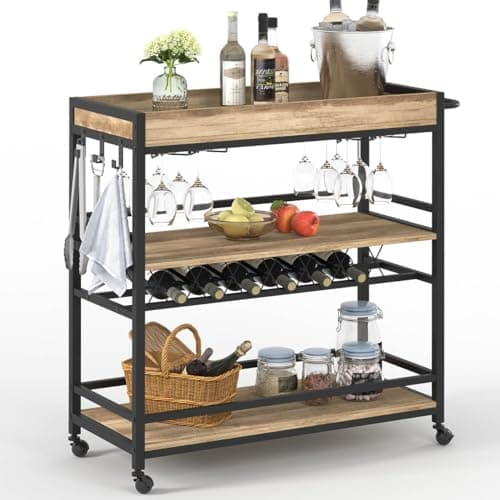
14.17 inches deep, 37.01 wide, 35.24 tall. 39.79 lb. 150 lb static load on each of three shelves, with two metal support rods under every shelf. MDF shelves with a vintage oak wood grain on a black sandy powder-coated metal tube frame. A wine rack listed for six bottles, two stemware racks listed for about twelve glasses, wrap-around rods on the shelves, three hanging hooks on the side, four wheels of which two have brakes, and a handle you can mount on either side. Roughly thirty minutes to assemble, hardware and instructions included.
Two notes on the numbers themselves. The bullets give the height as 35.23 inches with the handle and the specification table gives 35.24, which is the same cart measured twice. Less helpfully, the same listing also carries a size field reading 14.17 by 23.62 by 51.18 inches and another reading 14.17 by 35.2 by 11.81 — neither of which describes this object. The two fields that agree, and that match the manufacturer's own diagram, are Product Dimensions and Item Dimensions, both 14.17 by 37.01 by 35.24.
What 150 lb a shelf actually buys
Not capacity. That is the part worth being clear about, because the number invites you to imagine a cart that holds more than the others and it does not work that way.
A full 750 ml bottle weighs roughly 2.5 to 3 lb. So 150 lb is somewhere between fifty and sixty bottles on one shelf. A 37 inch shelf holds about twelve bottles in a single row, and about twelve is what the physical area allows before you start stacking, which you should not. The shelf runs out of room at roughly a quarter of its rating.
What the rating actually describes is the structure. Two support rods under each shelf is a real construction difference, and the practical effect is not what the shelf survives but what it does under everyday load: it does not bow, and a 37 inch board that does not bow in the middle is a genuinely different object from one that does. Board shelves sag slowly under a static load, and sag is what makes a cheap cart feel cheap two years in rather than on day one.
So the honest reading of 150 lb is: this shelf will still be flat when a 44 lb one has a dip in it. That is worth paying for. It is not a reason to put fifty bottles on it. The general argument about reading these figures is on bar cart weight capacity.
The clearance the listing buries
Here is the number that actually decides this purchase, and it is not in the bullets. It is in the listing's own answered questions: the space between the bottom of the wine rack and the bottom shelf is 11.8 inches.
A standard 750 ml wine bottle is published at 11.8 inches tall.
Those are the same number. A standing wine bottle under the rack has nominally zero clearance — it will go in, because published bottle heights vary by a fraction between producers and because the figure is rounded, but there is no margin in it at all. Anything with a taller neck, a longer capsule or a decorative closure does not stand there. A champagne bottle, published at 13 inches, is not close.
This is not a fault so much as a design consequence: the wine rack is hung under the middle shelf and it has to go somewhere. But it means the space under the rack is a lay-down space rather than a stand-up one, and if you were planning that as your bottle shelf, plan again. The full working on shelf gaps is on how much space is between bar cart shelves, and the champagne figure is on holiday bar cart ideas.
The 16.3 inch gap, which is the good news
The same listing publishes the space between the middle and bottom shelves as 16.3 inches in its bullets and 16.33 in its answered questions. Either way that is generous — most three-tier carts in the low thirties have something like 8 or 9 inches between shelves, so this is close to double.
It is generous enough to be genuinely useful. A 750 ml bottle at 11.8 inches stands there with four and a half inches to spare. A 3 quart ice bucket at around 8 inches tall fits with room above it, which on most carts it does not — the sizing argument is on ice buckets and tongs.
It is also, and this is worth knowing if you were considering it, about four tenths of an inch short of the 24-can beverage fridges people try to put on carts, which are published at roughly 16.7 inches tall. It misses. The wider case against that whole plan is on bar carts and mini fridges.
Storage, which is the real reason to buy it
Strip out the headline rating and what is left is the best storage geometry in our library. A wine rack for six laid-down bottles uses the dead space under a shelf that otherwise holds nothing. Two stemware racks for about twelve glasses take the stemware off the shelf entirely, and stemware is the worst use of shelf area there is — a coupe occupies nearly four inches of diameter to hold nothing.
Add three hanging hooks and wrap-around rods on the shelves and you have a cart where the open surfaces stay open. That is the difference between a cart that looks composed and one that looks like storage, and it is worth more day to day than any load figure.
At 14.17 inches deep it also takes a standard 12 by 16 inch serving tray flat, with a couple of inches to spare on the short edge. Which tray, and the arithmetic, is on bar cart trays.
MDF, and what that means
The oak is a wood grain applied over MDF. The listing says so, in the material field, and it also claims FSC-certified wood, which is a sustainability statement about the fiber rather than a claim that this is timber.
MDF is better than its reputation for this job. It is flat, it is dimensionally stable, and with two steel rods under it, it carries the published 150 lb. Its single weakness is water at an unsealed cut edge — usually the underside of a shelf's front lip, where the grain film stops — and the failure is permanent swelling rather than a stain. On a bar cart the pouring happens at the front lip, which is exactly where the weakness is, so a tray under the pouring area is not decoration here.
If you want actual timber, the field is on the wood cart roundup, and the honest summary is that the timber options cost more, weigh more and carry fewer racks.
Watch the model number
BON AUGURE lists several carts under adjacent model numbers and they are not the same object. This review is of BNG-BC1841-V, the vintage oak three-tier at 14.17 by 37.01 by 35.24 inches. A neighboring listing, BNG-BC1868-G, is published at 13.39 by 35.83 by 35.04 inches and 35.6 lb with faux marble shelves on a gold iron frame — a different cart in every dimension.
That matters because these listings share photography styling and a brand name, and because variant pickers on retail listings sometimes move. Check the model number in the specification block against the figures above before you order, rather than trusting the finish swatch.
Who should buy it
Somebody with a wall. Thirty-seven inches is a long cart — the second longest in our library — and it wants to own a stretch of wall rather than tuck beside a sofa. Given that, it is the best-specified cart on this site: the highest published shelf rating, the most storage per inch, a published shelf gap, and enough depth for a tray.
It is the top pick in the wood roundup and the industrial roundup for the same reasons, and it is the one cart on the site I would trust to carry an appliance.
Who should not
Anyone who needs the cart to move. At 39.79 lb this is past the line where a cart stops being a trolley and becomes furniture with wheels; you will position it once. Anyone with less than about forty inches of clear wall. Anyone who wants real wood rather than a grain over board. And anyone whose plan was to stand bottles under the wine rack, for the reason set out above.
If the room is tight, the honest alternatives are in small bar carts and tall, narrow bar carts.
What I would buy
The picks this page points to
These sit here rather than at the top on purpose: the advice above is what decides the choice, and a recommendation only means something once you know what you are choosing between.
Weight, and lots of it
BON AUGURE 3-Tier Bar Cart, Vintage Oak (BNG-BC1841-V)
BON AUGURE
The only wood cart I found that publishes a per-shelf figure anywhere near this: 150 lb on each of three shelves. At 37 inches it is the second-longest cart in our library, wide enough that it stops being a side table and becomes a counter. The catch is that the wood is a grain finish over MDF, not timber.
- Dimensions
- 14.17"D x 37.01"W x 35.24"H
- Weight
- 39.79 lb
- Load per shelf
- 150 lb, on all three
- Materials
- MDF shelves, metal tube frame
- Storage
- Wine rack for 6, stemware racks for 12
- Shelf gap, middle to bottom
- 16.3"
- Clearance under the wine rack
- 11.8"
Specs compiled from: BON AUGURE BNG-BC1841-V published listing, retrieved 2026-09-09.
What is good
- 150 lb a shelf is the highest published figure in our library, by 40 lb
- 14.17 inches deep takes a standard 12 by 16 inch tray flat
- A wine rack and two stemware racks stop glasses eating shelf area
What is not
- Vintage oak here is a wood-grain finish on MDF, not solid wood
- 37 inches wide needs a wall, not the gap beside a sofa
- The listing gives the height as both 35.24 and 35.23 inches and the width as both 37.01 and 37.12
#ad Disclosure · Price as of October 17, 2026
How these were picked
I have not tested any of these carts. What I did instead: compiled the published specifications from each listing, recorded the figures with their source, checked the footprint against the clearances a real room has, worked out how many standard bottles a stated shelf actually holds, and named the one I would skip. Where two listings for the same cart disagree, the page says so rather than quietly picking one.
Frequently asked
Questions
How much weight can the BON AUGURE BNG-BC1841-V hold?
Will a wine bottle stand up under the wine rack?
Is the BON AUGURE bar cart real wood?
How long does it take to assemble?
Does it fit a standard serving tray?
Sources
Where the facts on this page came from
- Standard 750 ml wine bottle dimensions — Dimensions.com
- Standard 750 ml champagne bottle dimensions — Dimensions.com
Specifications attributed to a retailer listing were read from that listing on the date shown on each product card. Listings change; if you find one that no longer matches what we published, tell us and we will check it and correct the page.
Read next
Related pages
Filed under Cart Reviews. Permanent link: /carts/bon-augure-bng-bc1841